Sourcing insect netting for humanitarian tenders, private label retail, or bulk distribution presents distinct operational hurdles. Whether you supply anti-malaria programs in sub-Saharan Africa or sell pop-up camping canopies in North America, order volumes dictate unit economics. Minimum Order Quantities (MOQs) often create friction between buyers seeking risk mitigation and mills running heavy industrial machinery.
At YAHE LN, we regularly collaborate with government buyers, global distributors, and retail importers to bridge these volume gaps. Factory requirements do not exist to turn away business; they reflect genuine mechanical and chemical production thresholds. Understanding how a manufacturer calculates minimums helps you secure optimal margins and design specifications.
Planning a commercial or tender purchase? Contact our technical sales engineers today to discuss custom batch runs, material specifications, and trial-order options tailored to your supply program.
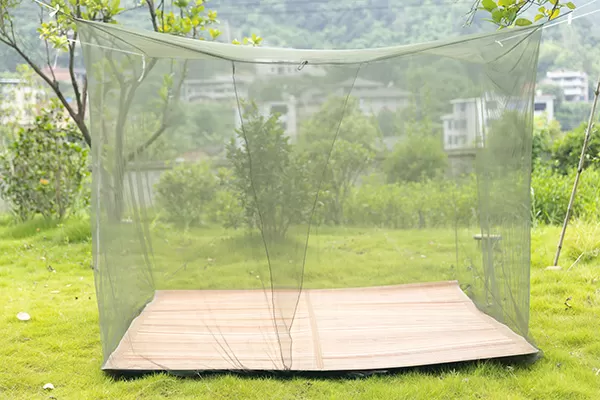
Core Technical Specifications: Polyester Mesh & LLINs
Textile performance in vector control depends on precise engineering standards. You cannot treat mosquito netting like ordinary apparel fabric. Small deviations in filament strength or hole geometry alter airflow, structural integrity, and protection levels against disease vectors like Anopheles mosquitoes.
Quality polyester netting relies on specific parameters:
- Yarn Denier (75D, 100D, 150D): Denier indicates linear mass density. A 75D yarn creates a lighter net suitable for compact consumer products, while 100D or 150D yields heavy-duty resistance preferred for humanitarian campaigns.
- Mesh Size (Holes per Square Inch): The baseline international benchmark remains 156 holes/inch² (approximately 25 holes/cm²). This layout balances mosquito prevention with breathability in high-humidity zones.
- Fabric Weight (GSM): Polyester mosquito net typically ranges between 28 and 45 Grams per Square Meter (GSM), depending on yarn count and knitting tension.
Long-Lasting Insecticidal Nets (LLINs) demand advanced processing. Unlike standard untreated netting, LLINs require chemical binding or extrusion where insecticides—typically synthetic pyrethroids such as deltamethrin or permethrin—adhere to polymer chains.
These nets must withstand a minimum of 20 standard laboratory washes under WHO Prequalification standards without forfeiting bio-efficacy. Applying these finishes requires specialized industrial machinery that must run at steady states to ensure chemical consistency.
Why Does a Polyester Mesh Mosquito Net Supplier Set an MOQ?
B2B buyers frequently ask why mills cannot run 200 custom-dyed nets with custom print bags. Factory minimums derive from physical process limitations rather than arbitrary sales targets. Understanding these constraints gives you clear leverage during negotiations.
1. High-Speed Warp Knitting Constraints
Mosquito nets rely on tricot or raschel warp knitting machines. Setting up a warp knitting creel requires loading hundreds of individual yarn spools (bobbins) and threading them by hand through guide needles. Preparing a modern multi-bar machine takes several shifts. Running small volumes wastes operational hours and consumes excessive setup yardage before machine tensions balance properly.
2. Industrial Dyeing and Heat-Setting Batches
Polyester fibers require high-temperature, high-pressure beam or jet dyeing systems. An industrial dye vessel typically holds anywhere from 300 to 1,000 kilograms of greige fabric. Running 50 kilograms in a massive vat leads to uneven dye dispersal, fabric streaking, and inflated energy overhead. After dyeing, the netting must pass through a stenter frame for heat-setting to stabilize dimensions. A continuous finishing line demands minimum run yardage to maintain heat balance.
3. Continuous Chemical Impregnation (LLIN Lines)
For LLINs, the liquid chemical bath requires strict continuous circulation to keep concentrations homogenous. When dipping fabric into pyrethroid emulsions, the padding, curing, and drying machinery runs as a continuous system. Starting and stopping this assembly line introduces chemistry variations that could fail batch toxicology and mortality testing.
4. Packaging and Component Minimums
Custom packaging adds secondary MOQs. Printing facilities produce full-color retail boxes, PVC zippered bags, and branded woven labels on fast gravure or flexographic presses. These third-party suppliers enforce their own floor minimums (often 3,000 to 5,000 units), which roll into your aggregate order requirements.
Industry Benchmarks for Polyester Netting & LLIN MOQs
While requirements differ across regions, historical factory norms provide a helpful reference point when building procurement budgets:
| Product Category | Customization Level | Typical Industry MOQ | Average Lead Time |
|---|---|---|---|
| Stock Polyester Mesh | White/standard colors, standard cut sizes | 500 - 1,000 pieces | 15 - 20 Days |
| Custom Color / Custom GSM | Pantone matching, non-standard denier (75D/100D) | 2,000 - 5,000 pieces | 30 - 40 Days |
| Certified LLIN Nets | Insecticide treatment, institutional labeling | 10,000+ pieces | 45 - 60 Days |
| Roll Goods (Netting Fabric) | Standard width, greige or ready-to-sew | 1,000 - 2,000 Kilograms | 20 - 30 Days |
Working with an integrated manufacturer like YAHE LN allows procurement teams to identify alternative setups. For example, selecting a white base material with customized border hems lets you produce distinct designs while bypassing raw-fabric dyeing thresholds.
Customization Factors That Directly Drive Up MOQs
Modifying netting features alters your operational starting point. The deeper your product specifications run, the higher the minimum production run becomes.
Mesh Density and Filament Changes
Departing from standard commercial density (156 holes/inch²) to tight sandfly/no-see-um mesh (300+ holes/inch²) requires machine re-gauging. Setting up specialized warp beams shifts baseline material orders from several hundred pieces into thousands of units.
Net Geometry and Stitching Labor
Simple rectangular box nets and conical hanging nets feed cleanly through automated sewing cells. Conversely, multi-pole pop-up tents, customized military cot nets, or wedge shapes require extensive manual work. When complex stitching increases labor hours, sewing operations demand longer runs to offset line setup times.
Flame Retardant and Hydrophobic Treatments
Adding flame retardancy compliant with standards like NFPA standards or CPAI-84 requires secondary chemical baths. Mills will not mix and cure specialty chemical baths for small volumes, because the chemical balance takes substantial volume to dial in safely.
4 Negotiation Tactics for B2B Buyers to Handle High MOQs
You can manage strict supplier requirements without overspending your capital. Experienced purchasing agents use deliberate strategies to maintain project flexibility:
1. Order Consolidation Across Multiple SKUs
If you offer three distinct net shapes (such as Conical, Box, and Pop-up), arrange to make all three from the identical fabric base (e.g., 100D, 35 GSM white mesh). The supplier weaves and dyes the collective fabric lot in a single run, dividing the processed roll goods across your varied patterns. This satisfies fabric thresholds while allowing product diversity.
2. Utilize Greige Fabric Inventory
High-volume manufacturers stock uncolored, un-treated greige rolls. If your application works with baseline white netting, source from existing greige lots. Bypassing upstream textile weaving cuts your minimum purchase volume down to sewing cut-and-make thresholds.
3. Negotiate Blanket Orders with Staggered Deliveries
Contract for your annual demand under a single purchase agreement, spacing physical deliveries into multiple shipments across the year. The factory gains production certainty and can buy raw yarns in bulk, while you lower your single-delivery logistics and warehousing costs.
4. Target a Structured Trial Batch
Suppliers review your long-term business case. When you present an explicit market roll-out strategy, many suppliers accept an initial trial order (typically 1,000 to 1,500 units) at a minor unit surcharge. This small initial fee covers setup inefficiencies while you assess end-market response.
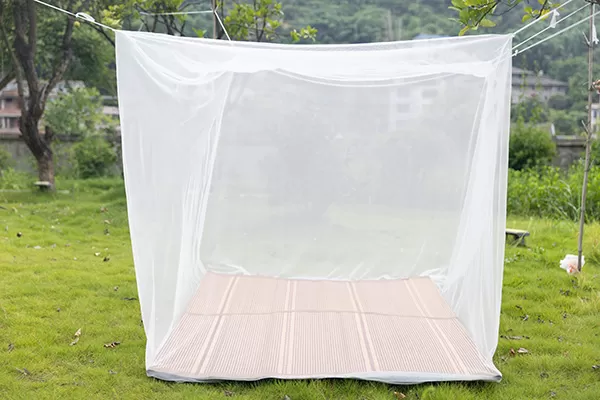
Evaluating a Reliable Polyester Mosquito Net Factory
Checking capability criteria protects you against quality defaults, non-compliant insecticide ratios, or delayed project milestones. Confirm these core supplier signals before issuing purchase orders:
- Verified Quality Management: Check for valid ISO 9001 registration across their knitting, dyeing, and conversion workshops.
- Chemical Safety Assurances: Request current testing reports confirming non-hazardous processing, like the OEKO-TEX Standard 100 certificate, assuring absence of harmful additives.
- Direct Extrusion and Finishing Lines: Factories running their own yarn drawing, knitting frames, and finishing baths offer lower minimums than contract packagers who outsource basic manufacturing steps.
- Transparent Tiered Quotations: Reliable vendors submit transparent price curves showing cost drops at 2,000, 5,000, 10,000, and 50,000 unit tiers.
Frequently Asked Questions (FAQ)
Q1: What is the typical polyester mesh mosquito net supplier MOQ for
private label designs?
A1: Standard custom private-label projects
typically require 1,000 to 3,000 pieces per colorway. This floor accommodates
custom consumer packaging and continuous fabric roll cutting without leaving
wasted inventory.
Q2: Why do LLIN mosquito nets have higher MOQs than standard
untreated nets?
A2: LLIN production calls for continuous industrial
dipping, pad-curing, and specialized insecticide-fixation systems. Running these
treatment systems safely demands substantial fabric volume to stabilize bath
concentration and verify WHO compliance.
Q3: Can I lower my order MOQ if I accept standard white
netting?
A3: Yes. Ready-to-cut stock white fabric circumvents
dyeing-vat and weaving-loom minimums. In these cases, MOQs usually drop down to
cut-and-sew packaging limits, often around 500 to 1,000 pieces.
Q4: How does yarn denier change unit pricing and minimum lot
sizes?
A4: Lighter 75D yarn contains more filament length per
kilogram than thicker 150D yarn. This creates more surface yardage per machine
pass, but requires higher knitting run times. A 75D specification may demand
higher piece quantities to fulfill loom weight rules.
Q5: Can mosquito net suppliers customize net hanging accessories at
low order volumes?
A5: Standard hardware (like simple steel screw
hooks and raw anchors) carries low minimum limits. Conversely, custom
injection-molded ceiling rings, printed carry cases, or pop-up fiberglass flex
frames normally enforce component-level factory runs starting at 2,000
pieces.
Secure Your Production Capacity with YAHE LN
Understanding production mechanics simplifies purchasing choices. Setting up machinery, calibrating dye runs, and managing chemical coating lines clarify why volume thresholds matter. Balancing your market launch requirements with these operational parameters sets your supply chain on solid ground.
As a seasoned manufacturing partner, YAHE LN blends advanced warping, dyeing, and treatment systems with adaptable client support. Whether your distribution requires millions of public health LLIN units or a targeted, commercial run of premium mesh nets, our staff helps configure specifications that protect your operating margins.
Ready to quote your upcoming netting program? Send an inquiry to our textile specialists now to receive factory-direct pricing, custom prototyping support, and tailored production schedules.