
Malaria prevention programs run on tight procurement deadlines and unforgiving compliance parameters. International donors and relief agencies require millions of long-lasting insecticidal nets (LLINs) each procurement cycle to combat vector-borne diseases. Sourcing agents cannot afford customs rejections, failed bioassays, or delayed factory consignments.
Procuring reliable treated mosquito net wholesale inventory requires a granular understanding of active ingredients, textile integrity, and institutional tender requirements. YAHE LN supports global procurement officers and NGOs by manufacturing certified, vector-control bed nets engineered specifically to clear international donor audits.
Are you preparing a tender bid for the Global Fund, UNICEF, or national health ministries? Contact our tender desk today to secure competitive factory pricing, production slots, and verified technical dossiers.
2026 Procurement Shifts: Navigating Treated Mosquito Net Wholesale
International mosquito net procurement has changed dramatically over the past two years. Standard pyrethroid-only nets no longer satisfy the technical requirements of high-transmission regions where vector resistance is widespread.
From Standard ITNs to Next-Generation Dual-AI LLINs
Mosquito populations across Sub-Saharan Africa and Southeast Asia show documented resistance to standard pyrethroid insecticides. In response, global donors prioritize dual-active ingredient (Dual-AI) and synergist-treated mosquito net wholesale procurement.
Modern bids focus on two primary next-generation categories:
- Pyrethroid-PBO Nets: These nets incorporate piperonyl butoxide (PBO), a synergist that disables the mosquito's metabolic defense enzymes, restoring the lethality of the pyrethroid.
- Dual-AI Nets (e.g., Chlorfenapyr + Pyrethroid): These introduce an entirely different chemical class with a unique mode of action. Chlorfenapyr disrupts the insect's cellular energy production, neutralizing resistant vector strains.
Major Tender Buyers and Their Stringent Compliance Barriers
Tender boards such as the Global Fund, the President's Malaria Initiative (PMI), and UN agencies enforce zero-tolerance policies regarding material specs. A successful treated mosquito net wholesale bid demands full traceability back to virgin raw polymer resin and registered chemical synthesis facilities.
Buyers must submit documentation demonstrating certified formulation stability, chemical retention profiles, and factory social accountability audits before cargo inspection even begins.
Decoding WHO Compliance: What Wholesale Buyers Must Verify Before Ordering
Submitting an uncertified product to a public health tender leads to immediate disqualification. Verifying WHO-compliant credentials early protects your bidding bond and commercial reputation.
WHO Prequalification (WHO-PQ) Status Explained
The WHO Prequalification Team (WHO-PQ) evaluates vector control products for safety, quality, and entomological efficacy. Buyers must cross-reference their supplier's exact manufacturing facility and product trade name against the active WHO-PQ Vector Control list.
Do not accept broad ISO declarations alone. A genuine WHO-PQ dossier confirms that the factory operates under continuous quality audits and uses validated chemical synthesis routes.
Bioassay and Wash Resistance Standards
WHO-compliant LLINs must retain their insecticidal efficacy after repeated laundering. International standards require nets to withstand at least 20 standardized laboratory washes while maintaining vector knock-down and mortality benchmarks.
- Knockdown Rate: High-grade LLINs must achieve greater than 95% knockdown within 60 minutes of exposure during WHO cone tests.
- Mortality Rate: Mosquito mortality must exceed 80% after a 24-hour post-exposure holding period.
- Wash Resistance Index: Lab protocols test chemical depletion rates to ensure the active ingredient remains bioavailable on the net surface across its 3- to 5-year operational lifespan.
Toxicity and Environmental Safety Regulations
Active ingredients must be lethal to target vectors while remaining completely safe for end-users, infants, and domestic animals. Wholesale suppliers must demonstrate that their microencapsulation and chemical incorporation processes prevent excessive surface migration of insecticides.
Suppliers must supply CIPAC analytical methods alongside material safety data sheets (MSDS) to prove zero toxic solvent leaching during transport, storage, and daily use.
Technical Specifications for Tender-Grade Treated Mosquito Net Wholesale
Every tender document specifies precise textile thresholds. Understanding these technical trade-offs allows buyers to optimize shipping weights and material budgets.
Fabric Selection: Polyester vs. High-Density Polyethylene (HDPE)
The choice of polymer determines the manufacturing technique, structural feel, and chemical-bonding mechanism of your bulk net order:
- Polyester (PES): Filament yarns are knitted into soft, flexible nets. The insecticide is applied via an advanced wash-resistant polymer coating over the fibers. Polyester nets pack down tighter, reducing sea freight volume.
- High-Density Polyethylene (HDPE): The insecticide is directly incorporated into the molten polymer masterbatch before monofilament extrusion. HDPE nets feature high mechanical abrasion resistance, making them ideal for rugged, rural deployments.
Mesh Size and Denier Breakdown
Tender documents establish precise mesh count thresholds to ensure vector exclusion without suffocating airflow in tropical climates.
Standard specifications require a minimum of 156 holes per square inch (approximately 24 holes/cm²). This spacing blocks Anopheles mosquitoes while promoting convective air circulation.
Yarn denier (fiber thickness) directly impacts net durability and total consignment mass:
- 75 Denier: Lightweight, economical choice common in emergency disaster relief nets where rapid distribution is prioritized.
- 100 Denier: The industry standard for public health tenders, balancing high tensile strength with budget efficiency.
- 150 Denier: Heavy-duty commercial grade engineered for military encampments, refugee operations, and harsh field environments.
Insecticide Formulations: Deltamethrin, Permethrin, and Alpha-Cypermethrin Dosages
Dosage targets depend on the specific pyrethroid and carrier substrate selected:
- Deltamethrin: Typically dosed at 55 mg/m² to 65 mg/m² on polyester net substrates.
- Alpha-Cypermethrin: Coated on polyester or incorporated into polyethylene at roughly 100 mg/m² to 200 mg/m².
- Permethrin: Extruded into HDPE netting at rates up to 20,000 mg/kg (2% w/w) for heavy-gauge operational nets.
Customization Capabilities for NGO & Government Tenders (OEM/ODM Wholesale)
Factory-level flexibility allows procurement teams to adapt nets to regional housing styles, military bivouacs, and strict donor branding regulations.
Custom Shapes & Dimensions: Rectangular vs. Conical
Rectangular nets offer the highest internal volume, keeping netting away from sleeping occupants to prevent bites through the fabric. They are standard for multi-person rural sleeping arrangements and institutional beds.
Conical (circular) nets require only a single ceiling suspension point. These models are popular for urban retail, mobile emergency response units, and health programs targeting single-bed households.
Colorways, Reinforcements, and Border Customization
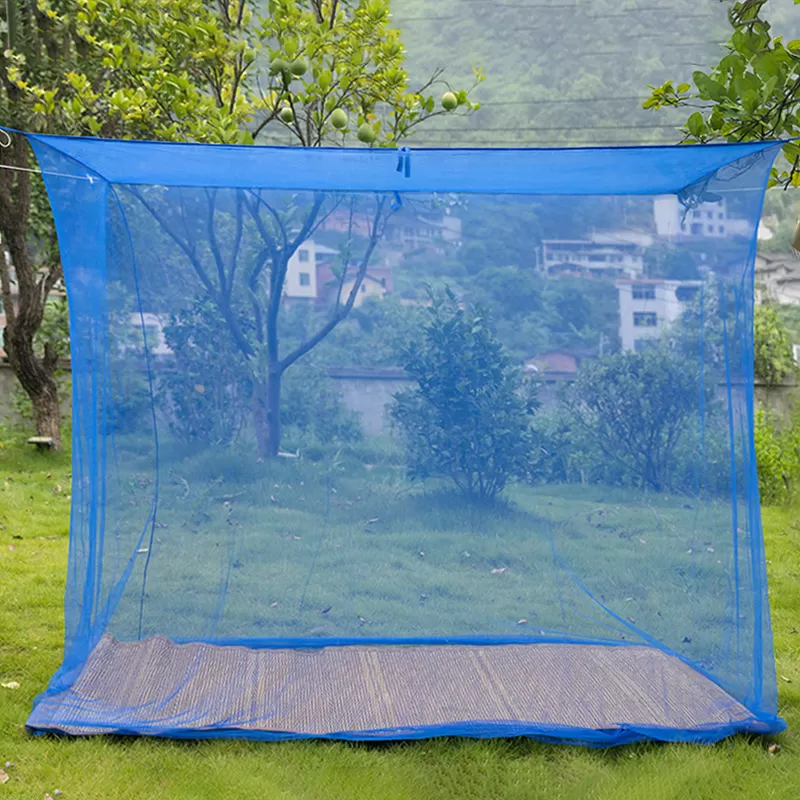
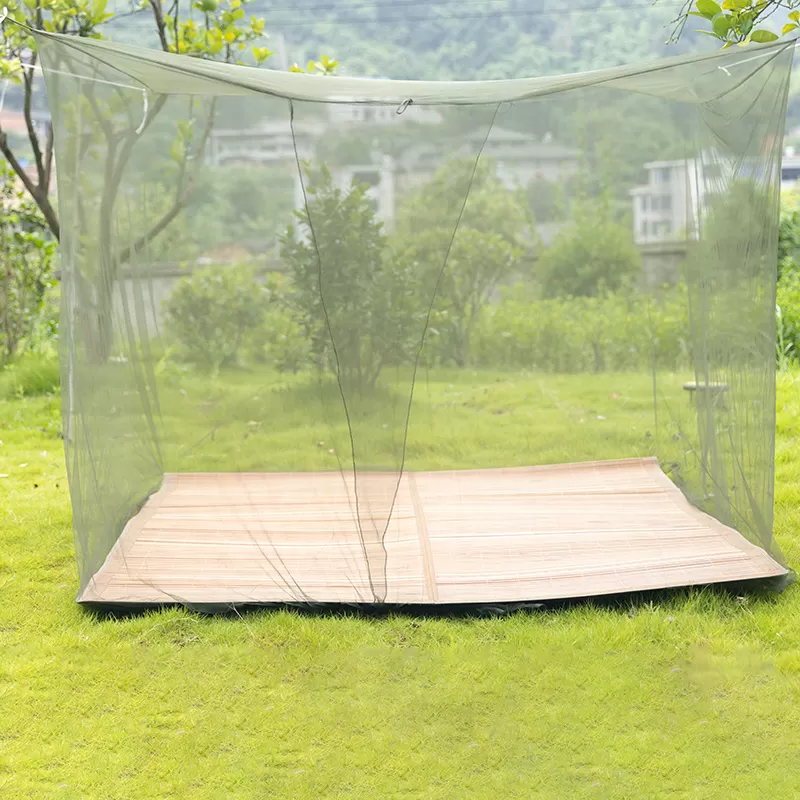
While white nets remain standard for clinical and hospital distributions, field operations often request specific color variations. Powder blue, olive green, and sand shades help conceal dirt and align with military or regional preferences.
To reduce wear along bed frames and rough floors, custom orders frequently specify a 15 cm to 30 cm reinforced sheeting border along the bottom base. This modification prevents premature tearing where mechanical abrasion occurs most frequently.
Donor-Compliant Packaging & Barcoding
Donor transparency requires robust tracking at the unit level. Advanced manufacturers like YAHE LN incorporate individual multi-color PE/PP outer packaging with customized print templates.
Packaging workflows support GS1-compliant barcodes, QR codes linked to digital batch tracking, and user instruction inserts printed in French, Portuguese, Swahili, Arabic, or English.
Quality Assurance & Third-Party Inspection Protocols
Rigorous pre-shipment inspections eliminate the financial exposure of defective container deliveries arriving at remote inland destinations.
Factory-Level Testing vs. Independent Labs
Reliable wholesale manufacturers operate internal quality testing laboratories to check yarn denier, chemical load, and knitting density off the loom every hour.
Before releasing final payment, international buyers contract independent testing agencies such as SGS, Intertek, or Bureau Veritas. Inspectors pull random samples per ISO 2859-1 sampling plans to verify that the entire lot matches contractual tender parameters.
Bursting Strength & Flammability Testing
Physical longevity tests prevent catastrophic tearing under normal community handling:
- Bursting Strength (ISO 13938): Nets must withstand a minimum pneumatic pressure, typically not less than 250 kPa for 75D polyester and up to 405 kPa for heavy-duty HDPE nets.
- Flammability (16 CFR Part 1610): Bed nets must comply with Class 1 flammability ratings to ensure the fabric does not ignite rapidly from unattended kerosene lamps or cooking flames.
Supply Chain Logistics: Managing Large-Scale Wholesale Deliveries in 2026
Efficient shipping logistics preserve project margins and ensure timely arrival during peak vector transmission seasons.
Container Optimization: Bale Packing vs. Compressed Pallets
Volume matters as much as gross weight in textile shipments. Standard folding wastes valuable container cube space.
Experienced suppliers utilize industrial hydraulic baling presses to compress and strap nets into 50- or 100-piece heavy-duty outer polywoven bales. Compressing the freight increases 40ft High Cube (HC) container capacity to approximately 65,000–85,000 units depending on denier, cutting ocean shipping costs per unit significantly.
Lead Times, Emergency Disaster Relief Stockpiling, and Cold-Chain-Free Stability
Producing half a million custom nets takes 30 to 45 production days, not including sea freight. Sourcing teams must structure procurement schedules ahead of regional monsoon periods.
For humanitarian organizations responding to sudden flooding, industrial suppliers maintain raw net stocks ready for rapid conversion. Because modern LLIN chemistries remain stable at ambient temperatures up to 40°C, consignments can be stored long-term in local warehouses without specialized climate control.
How to Choose a Vetted Treated Mosquito Net Wholesale Manufacturer (Buyer’s Checklist)
Before issuing your purchase order, run your shortlist of manufacturers through this strict procurement checklist:
- WHO Prequalification: Does the supplier provide a verifiable WHO-PQ listing for the exact factory site and product code?
- Production Capacity: Can the factory reliably produce at least 500,000 units monthly to mitigate late-shipment penalty clauses?
- Documented Track Record: Has the manufacturer executed large-scale contracts for the Global Fund, ministries of health, or verified relief agencies?
- Customization Agility: Can the engineering team deliver customized dimensions, reinforced borders, and multilingual donor artwork smoothly?
- Third-Party Inspection Support: Does the factory allow unfettered facility access to SGS, Intertek, or BV inspectors for in-line and loading checks?
Frequently Asked Questions (FAQ)
Q1: What is the minimum order quantity (MOQ) for custom treated
mosquito net wholesale orders?
A1: Standard production MOQs for
customized dimensions, colors, or specialized donor packaging generally start at
5,000 to 10,000 units. For off-the-shelf standard sizes in natural white,
factory minimums can be lower depending on current raw material inventory.
Q2: How do you verify the active ingredient dosage across a wholesale
batch?
A2: Chemical uniformity is verified via Gas Chromatography
(GC) or High-Performance Liquid Chromatography (HPLC) per official CIPAC test
methods. Independent testing labs take composite swatches from across production
runs to ensure the dosage matches target specs within declared tolerance
bands.
Q3: Can these treated nets be washed by end users without losing
insecticidal power?
A3: Yes. Certified LLINs maintain vector-killing
effectiveness for at least 20 standardized washes. Users should wash nets gently
in cold water with mild soap and dry them in the shade to protect the chemical
integrity.
Q4: What is the typical shelf life of wholesale treated mosquito nets
in hot warehouse conditions?
A4: Stored in original, undamaged
packaging away from direct sunlight, sealed LLINs maintain their chemical
efficacy for up to 3 to 5 years. Active ingredients remain chemically stable
even in ambient warehouse temperatures common across tropical regions.
Q5: What is the difference between an ITN and an
LLIN?
A5: Standard Insecticide Treated Nets (ITNs) require
re-treatment dipping after every few washes or every six to twelve months.
Long-Lasting Insecticidal Nets (LLINs) bind or incorporate the insecticide
directly into the synthetic fibers, maintaining active vector control for years
without chemical re-dipping.
Conclusion & Request for Tender Proposals (RFP)
Securing tender-compliant treated mosquito net wholesale inventory requires a partner who understands the high stakes of global vector control programs. A single specification failure can lead to rejected lots, financial penalties, and compromised communities.
YAHE LN brings years of textile manufacturing expertise, advanced chemical-bonding formulations, and dependable production lines to support your public health supply chain. Our team supplies complete technical documentation, pre-shipment testing reports, and competitive wholesale pricing tailored directly to your project tender specifications.
Contact our B2B procurement team today to discuss tender specifications, request a competitive quote, or arrange complimentary lab test samples for your technical evaluation committee.