Procuring vector control textiles for Sub-Saharan Africa requires strict attention to international compliance, production capacity, and field durability. Public health departments, non-governmental organizations, and commercial distributors face changing vector resistance patterns and tighter institutional guidelines in 2026.
Choosing an unverified trading intermediary can lead to delayed deliveries, failed port inspections, or compromised field efficacy. You need a vetted, direct manufacturer capable of delivering prequalified insecticidal nets on schedule.
Are you preparing an international tender or direct national distribution? Contact YAHE LN today to request our WHO-PQ documentation, TEC laboratory test reports, and custom LLIN factory pricing.

1. Why 2026 Procurement Demands a New Standard for an Export Africa Mosquito
Net Supplier
Malaria control programs across Africa face a serious obstacle: increasing pyrethroid resistance among Anopheles mosquitoes. As a result, the criteria for selecting an export Africa mosquito net supplier must shift from basic price evaluation to strict technical capability.
A simple commercial exporter sourcing generic polyester netting cannot meet the needs of modern distribution programs. Long-lasting insecticidal nets (LLINs) are specialized public health tools, not regular home textiles.
Buyers must examine three key structural shifts for 2026 programs:
Chemical Efficacy: Nets must maintain bio-efficacy against resistant vector populations through stable chemical formulation.
Regulatory Scrutiny: National malaria control programs (NMCPs) now enforce rigorous batch testing at entry ports to stop non-compliant imports.
Supply Chain Transparency: Institutional buyers demand full traceability from raw polymer resin to finished, packaged bales.
Selecting an experienced export Africa mosquito net supplier guarantees that every production run meets international health protocols and arrives on time.
2. The Baseline for Vetting: WHO-PQ and International Laboratory Validations
World Health Organization Prequalification (WHO-PQ) remains the gold standard for public health procurement. It confirms that an LLIN formulation meets international standards for safety, quality, and structural integrity.
However, paper certificates can be misleading. Buyers must independently verify that the factory name on the WHO-PQ listing matches the actual manufacturing facility, rather than a relabeled trading license.
The Benchmark of Long-Term Technical Investment
Top-tier suppliers show a sustained commitment to pesticide formulation and textile engineering. Consider YAHE LN as an industry reference. The company started specialized research on eco-friendly insect control in 2003 and secured its WHO-PQ listing in 2015.
This early validation is supported by multiple national invention patents and proprietary intellectual property. These investments separate genuine innovators from transient market brokers.
Third-Party Laboratory Verification
An export Africa mosquito net supplier must support internal testing with independent validation from Good Laboratory Practice (GLP) accredited centers. In-house data alone is not sufficient for major institutional tenders.
Dedicated Formulation Infrastructure: Leading manufacturers operate specialized chemical suites, such as YAHE LN's 200-square-meter standardized pesticide preparation laboratory.
European Lab Validations: Finished formulations must pass testing at independent institutions, such as the TEC laboratory in France.
Bioassay Testing: Verification requires standard WHO cone tests and tunnel tests to measure mortality rates and knock-down times against target vectors.
Insist on reviewing complete, unredacted third-party lab dossiers before issuing purchase orders or performance bonds.
3. Production Capacity and Supply Chain: Can Your Supplier Deliver 100,000+ Nets Daily?
National universal coverage campaigns require massive volumes delivered within tight distribution windows. Many trading agencies bid on contracts without holding dedicated factory capacity, leading to severe logistical bottlenecks.
A broken supply chain during rainy seasons leaves vulnerable populations exposed and exposes procurement teams to institutional penalties.
The Danger of Fragmented Subcontracting
Assembly-only suppliers buy mesh from third-party mills, send it out for chemical dipping, and then cut and sew across different workshops. This fragmented model introduces critical vulnerabilities:
Uneven insecticide distribution across different textile lots.
Fluctuating denier strength and bursting resistance across finished batches.
Production shutdowns caused by yarn shortages or local environmental closures.
The Vertical Manufacturing Advantage
A capable export Africa mosquito net supplier maintains direct control over every step: monofilament yarn extrusion, warp knitting, chemical finishing, and automated stitching. Vertical integration is the only reliable way to guarantee steady supply for multi-million-unit contracts.
YAHE LN proves this industrial scale through concrete operational assets:
An industrial footprint covering 66,700 square meters (over 100 mu).
Total capital investment exceeding 100 million RMB, yielding over 200 million RMB in annual output.
Daily output reaching 100,000 finished mosquito nets.
Daily fabric production capacity of 500,000 square meters of high-density mesh.
This production volume allows public health organizations to execute large-scale distributions on schedule without quality variances.
4. Custom LLIN Engineering: Ensuring Wash Resistance and Long-Lasting Efficacy
A net must withstand rough daily use in challenging rural environments. Sub-Saharan conditions expose textiles to harsh scrub washing, direct sunlight, and abrasive sleeping arrangements. A net that loses its active ingredient after several washes fails its primary protective purpose.
Substandard nets often show rapid active ingredient loss within 3 to 5 washes. That rapid decay leaves communities unprotected while offering a false sense of security.
Controlled-Release Chemical Engineering
A qualified export Africa mosquito net supplier uses advanced polymer extrusion or proprietary wash-resistant polymer coatings. The insecticide must migrate to the surface gradually to replace washed-off surface molecules, maintaining a lethal dose for mosquitoes over several years.
YAHE LN addresses this through proprietary controlled-release technology. The chemical formulation bonds within the matrix, retaining lethal bio-efficacy after more than 21 standardized WHO washes. This performance delivers sustained vector control across a 3 to 5-year operational lifecycle.
Custom Specifications for Regional Program Needs
Tenders across different countries require unique textile and design specifications. A reliable export Africa mosquito net supplier easily adapts to these project requirements:
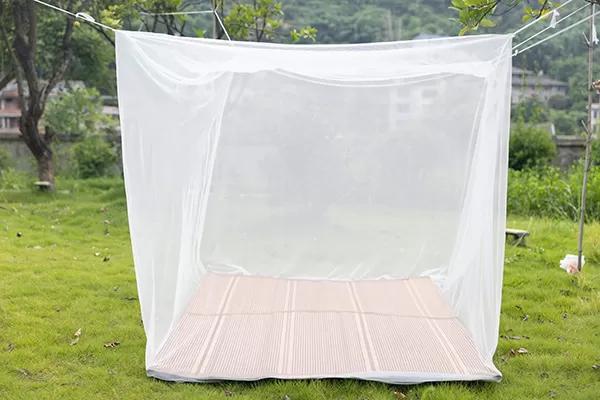
Structural Profiles: Circular/conical nets with cross-over tops for single-point hanging, or reinforced rectangular box nets for multi-occupant family sleeping mats.
Textile Metrics: 75D, 100D, or 150D yarn options, combined with custom mesh ratings (e.g., 156 holes per square inch) to balance airflow and bite prevention.
Mechanical Strength: High-tensile border stitching, reinforced hanging loops, and tear-resistant lower skirts to resist floor friction.
Formulation Diversity: Custom active ingredient loading to align with national vector management and resistance guidelines.
5. Tender Eligibility: ESG Architecture and Institutional Track Record
Global financiers like The Global Fund, USAID/PMI, and UN agencies enforce strict Environmental, Social, and Governance (ESG) guidelines. Sourcing from non-compliant suppliers puts projects at risk of sudden contract cancellations and audits.
Your chosen export Africa mosquito net supplier must prove corporate responsibility alongside chemical performance.
Verified Institutional Track Record
A supplier’s past performance is the best indicator of future reliability. High-volume manufacturers must demonstrate successful, long-term supply relationships with demanding aid groups.
YAHE LN serves as an established supply partner to premier international humanitarian organizations, including UNICEF and UNHCR. Working with these entities proves our ability to handle complex export paperwork, pre-shipment inspections, and international ocean logistics.
Formal Management Systems
Operational stability requires documented operational systems. Verify that your export Africa mosquito net supplier maintains three primary management certifications:
ISO 9001: Verifies continuous quality control throughout the manufacturing lifecycle.
ISO 14001: Confirms compliant wastewater treatment, responsible chemical disposal, and emissions management.
ISO 45001: Proves safe working conditions, fair labor practices, and factory safety protocols.
Backing these operational frameworks, YAHE LN contributes over 10 million RMB annually in local enterprise taxes. This fiscal standing confirms corporate stability, protecting global clients from sudden regulatory closures or labor disputes.
6. Partnering with YAHE LN: Your Verified Export Africa Mosquito Net Supplier for 2026
Selecting the right manufacturing partner protects public health budgets and ensures aid programs run smoothly. A successful LLIN procurement program depends on verified field performance, guaranteed output, and strict institutional compliance.
YAHE LN brings together the essential operational capabilities needed for large-scale malaria prevention:
Proven Regulatory Status: Continuous WHO-PQ prequalification supported by proprietary formulations and French TEC laboratory evaluations.
High Manufacturing Capacity: Daily production of 100,000 finished nets across a fully integrated, 66,700-square-meter facility.
Field Durability: Engineered retention exceeding 21 standard washes for 3 to 5 years of active vector protection.
Audit-Ready Systems: Complete ISO triple certification, ESG accountability, and an established supply record with UN agencies.
Avoid the risks of unverified intermediaries and production delays. Work directly with an established manufacturer to secure your 2026 distribution timeline.
Contact our export engineering desk today to request product specification sheets, regulatory dossiers, or custom production samples for your upcoming tender.
Frequently Asked Questions (FAQ)
Q1: How can I verify if an export Africa mosquito net supplier has
true WHO-PQ approval?
A1: Review the official WHO Prequalification
of Vector Control Products list online. Confirm that the factory’s registered
corporate name, manufacturing site address, and brand reference match the
documentation provided. Genuine suppliers will readily share their PQ product
reference number and corresponding evaluation reports.
Q2: Why is the 21-wash threshold so critical for LLIN tenders in
Africa?
A2: Standard public health nets must protect communities for
several years under regular use. The WHO 21-wash test simulates several years of
heavy domestic washing. If a net loses its active ingredient after 3 to 5
washes, it ceases to kill or repel vectors, exposing users to malaria
transmission.
Q3: What lead time is standard for a 500,000-unit custom LLIN
order?
A3: Integrated manufacturers like YAHE LN typically finish
production for 500,000 custom units within 15 to 25 production days thanks to
their 100,000-net daily output. Intermediaries or non-integrated mills often
require 60 to 90 days because they rely on outsourced weaving and treatment
processes.
Q4: Can we order custom colors and custom denier strengths for
institutional programs?
A4: Yes. An experienced export Africa
mosquito net supplier can adjust polymer extrusion to produce 75D, 100D, or 150D
netting in white, blue, green, or custom agency colors. They can also
manufacture both rectangular family configurations and circular
ceiling-suspended designs.
Q5: What shipping and packaging standards are required for African
port clearance?
A5: Large shipments typically move in compressed,
waterproof, tamper-evident bales wrapped in heavy polypropylene to maximize
container space and protect against moisture. Outer bales must display
standardized project markings, QR tracking codes, and inspection stamps to
ensure smooth clearance through customs checkpoints.
Request Your 2026 LLIN Manufacturing
Consultation
Submit your tender requirements, denier preferences,
and destination ports to our team. We will deliver complete technical
documentation, GLP/TEC lab reports, and wholesale FOB/CIF quotations within 24
hours.