
Procuring insecticidal bed nets at scale involves high stakes. A single batch of sub-par nets can compromise regional disease control programs, waste institutional budgets, and cost human lives. When international relief agencies, ministries of health, and commercial distributors issue tenders, they do not just purchase mesh fabric; they invest in predictable biological efficacy and material durability.
Long-Lasting Insecticidal Nets (LLINs) serve as the primary frontline defense against vector-borne illnesses, specifically malaria. Because of their critical role, the World Health Organization (WHO) enforces strict technical standards through its Prequalification (PQ) team. Yet, the gap between a generic textile workshop and a certified, precision-driven mosquito net factory is immense.
Elite manufacturers, including established producers like YAHE LN, design their entire operational infrastructure around these global health mandates. If your organization is preparing a large-scale procurement tender, contact our supply specialists today to request technical dossiers, WHO-aligned testing reports, and production line verification.
1. Decoding WHO Standards: The Non-Negotiable Benchmarks for LLINs
The World Health Organization evaluates bed nets through precise chemical, physical, and entomological criteria. A standard textile cannot survive the environmental rigors of high-transmission endemic zones. A certified mosquito net factory must consistently meet three fundamental engineering metrics:
- Chemical Retention and Bio-efficacy: The net must retain active pyrethroid insecticides (such as deltamethrin, permethrin, or alpha-cypermethrin) across its lifespan. The surface concentration must continuously release insecticide to eliminate mosquitoes on contact without endangering sleeping occupants.
- Wash Resistance: WHO criteria dictate that an LLIN must maintain its lethal action and repellent characteristics even after a minimum of 20 standardized laboratory washes. Sub-par nets experience active ingredient wash-off within the first three cycles.
- Structural Durability: The fabric must withstand heavy friction, snagging, and daily wear in rural dwellings. Parameters include a bursting strength exceeding 250 to 405 kPa (depending on fiber type), a minimum denier rating (typically 75D to 100D for polyester, or 100D to 150D for polyethylene), and an exact mesh density of not less than 156 holes per square inch.
2. Inside an Elite Mosquito Net Factory: Four Pillars of Manufacturing
Meeting international health specifications demands rigorous process control from virgin polymer to final packaging. A top-tier mosquito net factory operates far beyond the capabilities of cut-and-sew operations by integrating automated textile engineering with chemical synthesis.
2.1 Raw Materials and Polymer Masterbatch Extrusion
Low-cost suppliers often spray finished polyester mesh with chemical binders, a method prone to rapid wash-out and peeling. In contrast, an advanced mosquito net factory utilizes polymer incorporation technology, particularly for high-density polyethylene (HDPE) nets.
In this system, technical operators blend technical-grade insecticides directly into the masterbatch resin beads before fiber extrusion. As the monofilament yarn is drawn, the active ingredient distributes uniformly throughout the entire molecular structure. When surface molecules deplete through washing or abrasion, the reservoir within the core migrates to the surface, creating a continuous chemical regeneration cycle.
2.2 Industrial Warp Knitting Precision
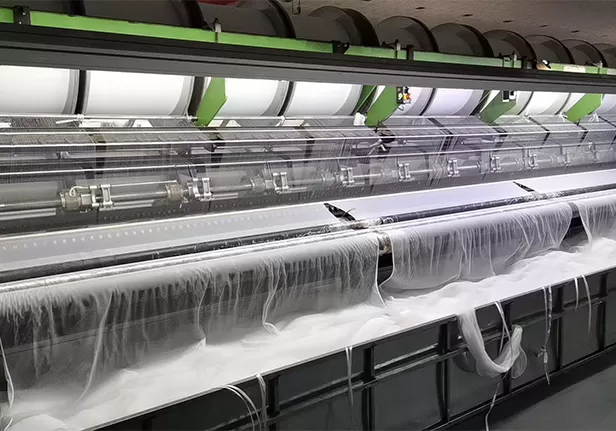
Fabric geometry directly controls ventilation, user comfort, and mosquito exclusion. Elite manufacturing plants deploy high-speed tricot or Raschel warp-knitting machines running multi-filament yarns under calibrated tension.
These industrial machines prevent tension variances that lead to irregular hole dimensions. An undersized mesh restricts vital airflow in humid, tropical climates, prompting users to abandon the net. An oversized mesh allows vector entry. Advanced warp knitting guarantees dimensional stability, ensuring every single aperture meets international specifications.
2.3 Environmental and Chemical Safety Protocols
Handling chemical insecticides at high industrial volume requires uncompromising safety architecture. A responsible mosquito net factory implements closed-loop dosing systems to protect line technicians from direct chemical exposure.
Facilities like YAHE LN build their production around clear environmental guidelines. Industrial scrubbers process exhaust air, wastewater treatment stations capture chemical runoff, and automated monitoring safeguards local ecosystems. Furthermore, finished netting must secure OEKO-TEX Standard 100 or equivalent certifications to prove zero hazardous residues reach the consumer.
2.4 High-Capacity Cutting, Sewing, and Packaging
Humanitarian emergencies and national distribution programs require massive volumes within narrow logistical windows. Top factories maintain monthly outputs exceeding 500,000 to 1,000,000 finished units.
Automated laser cutting eliminates frayed fabric edges, while reinforced multi-needle lockstitch machines secure critical stress zones, such as hanging loops and hem skirts. Clean packaging rooms insert individual units into tamper-proof, UV-blocking polyethylene wraps that shield the active chemicals from photodegradation during long transit routes.
3. The Testing Laboratory: Rigorous In-House Quality Verification
You cannot manage what you do not measure. A qualified mosquito net factory maintains an internal laboratory equipped to mirror the analytical rigor of independent testing bodies like SGS or Intertek.
Quality engineers run continuous evaluations on every production lot, focusing on three core areas:
- WHO Cone Bioassays: Live, susceptible mosquito colonies (typically Anopheles gambiae or stephensi) are exposed to production samples within transparent plastic cones for three minutes. Technicians measure knockdown rates at 60 minutes and total mortality after a 24-hour holding period. Knockdown must consistently hit 95% or higher, with mortality clearing 80%.
- Standard Wash Stations: Fabric samples undergo mechanical washing cycles at precise temperatures and detergent chemistries, matching the strict CIPAC guidelines required by WHO protocols. Engineers verify that the slow-release insecticide remains fully potent after consecutive wash phases.
- Bursting Strength and Tear Analyzers: Pneumatic testers place fabric swatches under pressurized diaphragms until rupture occurs. The machine records the exact pressure threshold in kilopascals (kPa), proving the net can survive harsh field deployments without ripping.
4. Standard Supplier vs. WHO-Compliant Factory: B2B Comparison
Discerning procurement officers must separate cosmetic copycats from genuine industrial manufacturers. Review the side-by-side technical distinctions below:
| Assessment Criteria | Standard Commercial Workshop | Elite WHO-Grade Mosquito Net Factory |
|---|---|---|
| Insecticide Application | Manual cold-dipping or surface spraying; degrades rapidly. | Polymer masterbatch incorporation or permanent fluorochemical-bound coating. |
| Wash Durability | Loses efficacy after 2 to 5 domestic washes. | Maintains bio-efficacy past 20 standardized WHO wash cycles. |
| Quality Testing | Visual inspection only; zero entomological testing. | In-house cone bioassays, HPLC chemical assays, and pneumatic burst testing. |
| Traceability | No lot-level tracking; missing chemical documentation. | Complete batch coding printed on labels; full raw material track-and-trace. |
| Production Scale | Low volume (under 50,000 units/month); seasonal delays. | High-capacity automated flow (500,000+ units/month) with buffer inventories. |
| Compliance Audits | Lacks environmental approvals; variable labor conditions. | ISO 9001, ISO 14001, ISO 45001, SMETA, or BSCI certified operations. |
5. Buyer's Audit Protocol: How to Vet a Mosquito Net Factory
Brokers and trading houses often claim full WHO compliance while outsourcing jobs to unregulated sub-contractors. When you conduct physical or digital site inspections, demand direct evidence of the following technical indicators:
1. Verify the WHO Prequalification Listing: Confirm that the plant produces formulations listed on the official WHO Prequalified Vector Control Products registry. Request original, unredacted laboratory trial documents that connect the manufacturing location directly to the PQ dossier.
2. Inspect the Yarn Source and Extrusion Lines: Look at where the yarn originates. A dependable mosquito net factory processes its own fibers or holds long-term, direct procurement contracts with verified polymer chemical suppliers. Ask to see raw material Certificate of Analysis (CoA) records for every resin shipment.
3. Review the Chemical Dosing Logs: Walk the chemical preparation bays. Automated flow meters, computerized recipe managers, and strict inventory reconciliation logs show that active ingredients are measured accurately rather than estimated by hand.
4. Audit Social and Environmental Standards: Responsible brands ensure fair labor conditions. Validate that the facility possesses active SMETA (Sedex) or BSCI social compliance audits alongside zero-discharge wastewater certificates.
Frequently Asked Questions (FAQ)
Q1: What is the primary difference between an ITN and an
LLIN?
A1: An Insecticide-Treated Net (ITN) is
typically a standard net dipped in insecticide, requiring re-treatment every six
months or after three washes. A Long-Lasting Insecticidal Net (LLIN)
manufactured by an advanced mosquito net factory blends
chemical agents directly into the fiber matrix or binds them permanently. LLINs
maintain biological efficacy for at least three years or 20 standardized washes
without chemical reapplication.
Q2: Why is the denier rating critical for bulk institutional
purchases?
A2: Denier measures the linear mass
density of the yarn (grams per 9,000 meters). A 75D or 100D polyester thread or
100D to 150D polyethylene thread determines structural resistance against
tearing. Lower denier fabrics might save initial unit costs, but they tear
easily in rugged environments, failing physical durability audits long before
the insecticide depletes.
Q3: How does a certified mosquito net factory prevent vector
resistance?
A3: Mosquito populations can develop
metabolic or target-site resistance to standard pyrethroids. Leading
manufacturers like YAHE LN build next-generation nets
incorporating synergists like Piperonyl Butoxide (PBO) or dual-active
formulations (combining pyrethroids with chlorfenapyr or pyriproxyfen) to
neutralize resistant vector strains.
Q4: What is the standard lead time for an order of 500,000 bed
nets?
A4: Production timelines depend on yarn stock
availability and ongoing queue reservations. A well-equipped mosquito
net factory generally requires four to eight weeks to extrude, knit,
sew, and package an order of this magnitude, followed by regional ocean freight
times.
Q5: Can private commercial distributors order customized branding on
WHO-grade nets?
A5: Yes. Industrial factories offer
OEM/ODM arrangements. Buyers can specify tailored dimensions, customized
boundary trims, unique hanging rig sets, and custom-printed inserts, provided
the alterations do not modify the prequalified technical composition of the
insecticidal mesh.
Partner with an Elite LLIN Manufacturing Specialist
Choosing an unvetted supplier risks customs rejections, failed border inspections, and product recalls. When public health is on the line, manufacturing pedigree matters. Global procurement groups depend on verifiable quality systems, traceable chemical records, and on-time industrial delivery.
As a seasoned mosquito net factory, YAHE LN aligns every production stage with the strictest global health expectations. Our automated processing floors, modern testing laboratories, and high-volume logistics handling ensure that your order performs effectively in the field.
Ready to secure your supply chain? Contact our technical sales team right now to review factory certifications, request wholesale quotations, or schedule an inspection of our manufacturing facilities.