
Vector control procurement is undergoing a major structural shift. As national malaria programs, humanitarian agencies, and commercial hospitality operators prepare their forward pipelines, technical criteria for long-lasting insecticidal nets (LLINs) have tightened.
Procuring a circular mosquito net bulk shipment now requires deeper technical due diligence than simply checking base fabric weight. Manufacturers must address pyrethroid resistance, tighter chemical-binding polymer matrixes, and strict international shipping economics.
Facilities like YAHE LN design and manufacture high-performance conical nets that meet these exact humanitarian and private-sector specifications. This review breaks down the 2026 production criteria, testing protocols, and logistics benchmarks necessary for large-scale procurement tenders.
2026 WHO-Prequalification Vector Standards: The Dual-Active Shift
Standard pyrethroid-only nets no longer provide sufficient protection across high-transmission zones in Sub-Saharan Africa and Southeast Asia. Resistant Anopheles populations break down single-chemistry treatments quickly, rendering basic nets ineffective after brief field deployment.
The updated 2026 procurement frameworks prioritize dual-active ingredient (Dual-AI) chemistry. These formulations combine classic pyrethroids with either a synergist or a completely different chemical class:
Pyrethroid-PBO Formulations: Piperonyl butoxide (PBO) inhibits the metabolic enzymes (cytochrome P450s) that resistant mosquitoes use to neutralize pyrethroids.
Chlorfenapyr Blends: Chlorfenapyr disrupts ATP production in mosquito mitochondria. Because this chemistry targets cellular energy rather than the nervous system, cross-resistance remains near zero.
Pyriproxyfen (PPF) Co-treatments: An insect growth regulator that sterilizes female vectors, cutting reproductive output across targeted regions.
When sourcing a circular mosquito net bulk consignment for tenders, buyers must verify chemical retention rates. Under WHO guidelines, the netting fabric must retain bio-efficacy across 20 standardized washes.
Meeting this benchmark requires complex extrusion technology. Active ingredients are not simply sprayed onto finished textiles; factories melt-blend them directly into polymer pellets before yarn spinning, ensuring a controlled bleed rate throughout the net's lifespan.
Material Science & Structural Engineering for Bulk Conical Nets
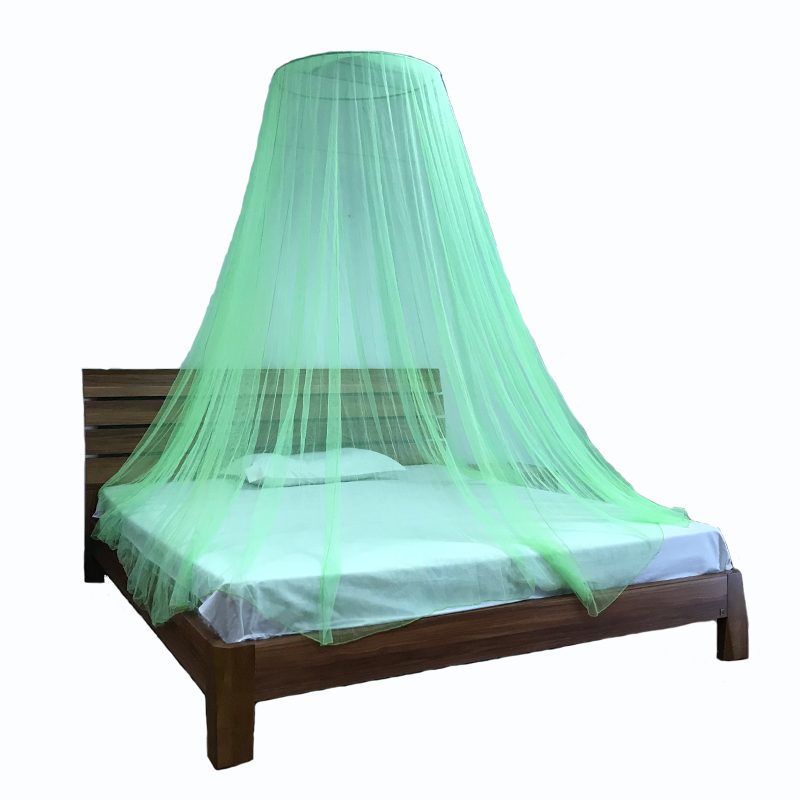
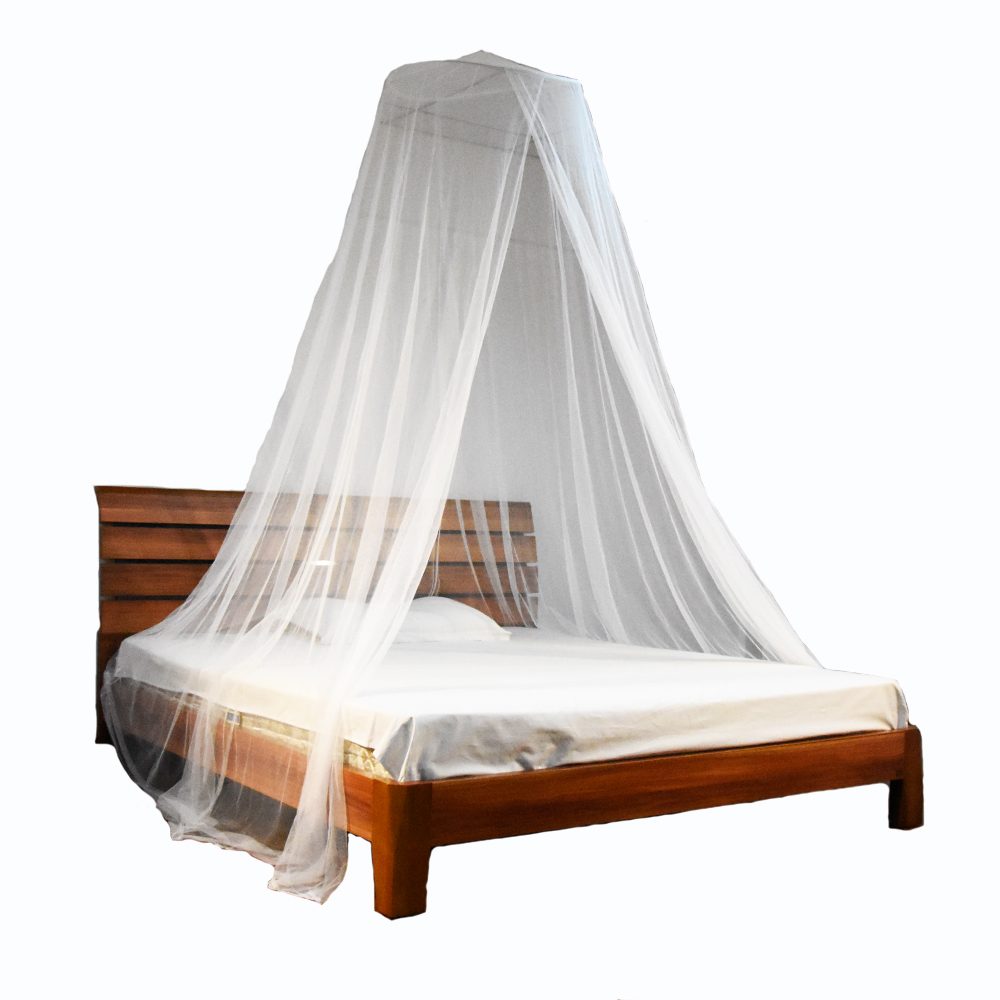
Circular, or conical, nets offer a distinct tactical advantage over rectangular designs: they suspend from a single overhead anchor point. This makes them the preferred choice for rapid humanitarian relief, seasonal domestic deployment, and safari hospitality projects.
However, single-point suspension creates localized mechanical tension. The apex and the structural ring bear the weight of the entire fabric drape. Choosing the wrong filament specification guarantees tears along the seams.
Polyester (PES) vs. High-Density Polyethylene (HDPE)
Procurement teams evaluate two core yarn polymers for conical LLIN projects:
Polyester (PES): Typically sourced in 75-denier or 100-denier multifilament yarn. Polyester provides superior airflow, soft drape, and comfortable tactile qualities. It features an optimal bursting strength between 250 and 350 kPa.
High-Density Polyethylene (HDPE): Extruded as a monofilament, generally at 150 denier. HDPE yields extreme tear resistance (bursting strength >450 kPa), making it ideal for rugged humanitarian field camps. However, it increases total pack volume and weight.
For high-volume distribution, the global standard remains 100% multifilament polyester at 156 holes per square inch (mesh count). This balance blocks target vectors while allowing natural cross-ventilation in hot, humid climates.
Apex Reinforcement and Anti-Abrasion Skirts
A standard circular mosquito net bulk order must survive aggressive real-world conditions. High-stress points require mechanical reinforcement during cutting and sewing.
The top cone anchor point must feature high-density polyester tape or cross-stitched nylon webbing to distribute tensile strain. Furthermore, the lower hem edge—the part repeatedly tucked under bed mattresses or ground mats—should incorporate an anti-abrasion skirt (a double-folded, reinforced 10-15 cm border band).
Hoop Mechanics: Optimizing CBM and Freight Expenses
Freight costs represent a major variable in global tender contracts. Conical nets require a circular ring at the crown to expand the netting canopy outward from the single suspension point. Poor ring design inflates container volume and drives up landed costs.
Manufacturers solve this engineering challenge using two main ring styles:
Flexible Pop-Up Spring Steel: A high-tensile steel wire loop that folds down into a tight, three-circle spiral. Once unpacked, it snaps open automatically. This design delivers maximum packaging efficiency.
Segmented Knock-Down Plastic Hoops: Interlocking PVC or fiberglass segments assembled on site. While inexpensive, they increase pack assembly time for end users.
Factory teams at YAHE LN run continuous mechanical stress cycles on pop-up spring steel frames. The spring core must retain its memory shape through tight bailing and high-temperature container transport, preventing hoop warping upon deployment.
Adopting flat-pack folding rings cuts the packaged unit volume (CBM) by 35% to 42% compared to rigid rings. Over an entire procurement contract, this reduction translates directly into tens of thousands of dollars in freight savings.
Production Scalability & Quality Control Systems
Executing an international tender requires industrial manufacturing infrastructure. Consistent production relies on a controlled, five-phase manufacturing workflow:
Masterbatch Compounding: Insecticide concentrates and pigment masterbatches are mixed into virgin polymer resin chips under precise heat controls.
Filament Spinning: High-speed extruders pull polymer yarns at precise denier tolerances. Continuous laser monitors verify thread consistency.
Warp Knitting: High-gauge Karl Mayer tricot machines weave the filament into non-slip, tear-resistant hexagonal or diamond mesh structures.
Thermal Setting & Curing: Net fabrics run through continuous stenter frames to lock in mesh dimensions, remove fabric stress, and fix chemical coatings.
Automated Cut & Sew: Industrial cutting tables size the conical gores, which sewing teams assemble using reinforced lock-stitch seams.
Every commercial circular mosquito net bulk run requires systematic batch testing. Factory quality-control technicians pull random swatches to run gas chromatography (GC) tests, confirming targeted surface bioavailability of the insecticide.
In-house burst-strength testers apply pneumatic pressure to verify fabric integrity against ISO 13938-2 standards. Any batch failing structural resistance or active ingredient concentration is immediately pulled from the production line.
Container Packing Algorithms: Maximizing 40HQ Efficiency
Container optimization dictates final landed pricing. The table below details packing density, weight distributions, and logistics calculations for standardized single-point circular nets across common shipping configurations:
| Net Specification | Dimensions (Ring × Height × Base) | Units per 20GP Container | Units per 40HQ Container | Packaging Format |
|---|---|---|---|---|
| 75D Polyester Conical (Single) | 50 cm × 230 cm × 850 cm | 12,000 pcs | 28,500 pcs | Vacuum Bales (50 pcs/bale) |
| 100D Polyester Conical (Double) | 60 cm × 250 cm × 1050 cm | 9,500 pcs | 22,000 pcs | Vacuum Bales (40 pcs/bale) |
| 100D Polyester Conical (King) | 65 cm × 270 cm × 1250 cm | 8,000 pcs | 18,500 pcs | Compressed Cartons (25 pcs/ctn) |
| 150D HDPE Monofilament (Queen) | 60 cm × 250 cm × 1150 cm | 6,200 pcs | 14,800 pcs | Heavy-Duty Bales (30 pcs/bale) |
Vacuum-compressed baling remains the preferred format for government tenders and crisis aid shipments. Heavy woven polypropylene outers protect compressed nets from moisture, grease, and punctures throughout multi-leg transit routes.
For commercial hospitality and private label retail, custom individual packaging—such as printed 210D Oxford zippered carry bags—can be packed directly into master export cartons with barcodes and customs compliance labels attached.
Regulatory Compliance and ESG Commitments
Procurement boards now demand environmental accountability alongside physical quality. Bidding programs under Global Fund or UNICEF frameworks verify factory ESG systems before issuing awards.
Mills must comply with ISO 14001 environmental management standards and hold ISO 9001 quality certifications. Water runoff from washing trials must pass through biological filtration plants, ensuring zero untreated chemical discharge.
Modern production facilities run complete supply-chain traceability. Every shipping carton features individual lot numbers, QR tracking codes, and mill timestamps. This documentation allows procurers to track finished nets back to raw polymer lots, confirming safety and regulatory standards.
Frequently Asked Questions (FAQ)
Q1: What is the minimum order quantity (MOQ) for custom circular mosquito net bulk production?
A1: Standard factory MOQ begins at 2,000 units for standard white polyester configurations. Custom colors, specialized yarn deniers, or proprietary insecticide formulations generally require a minimum production run of 5,000 to 10,000 units to support specialized masterbatch compounding.
Q2: How does the pop-up spring ring withstand high-pressure baling?
A2: Rings use high-carbon spring steel coated with anti-corrosion zinc. The steel is heat-treated to resist permanent deformation. When compressed under hydraulic balers, the rings flex flat. Once the bale bands are cut on site, the hoops spring back into their original circular shape without metal fatigue.
Q3: Can circular nets be treated with Chlorfenapyr for institutional aid tenders?
A3: Yes. Manufacturing facilities can run custom compound masterbatches that incorporate Chlorfenapyr or Chlorfenapyr-pyrethroid dual formulations. These treatments comply with the latest WHO pesticide evaluation guidelines for regions facing extreme pyrethroid resistance.
Q4: What is the typical sampling and bulk lead time for contract manufacturing?
A4: Lab-dip and structural pre-production samples require 7 to 10 days. Once production samples are approved and testing finishes, factories deliver full 40HQ container runs (roughly 20,000 to 28,000 units) within 25 to 35 days, depending on active order books.
Q5: Can packaging be customized with donor agency logos and local languages?
A5: Yes. Institutional orders can be customized with multilingual care labels, USAID/UNICEF compliance markings, tracking barcodes, and donor logos. Options include heat-transfer labeling, sewn-in woven tags, and flexographic printing on exterior bale wraps.
Secure Your 2026 Production Window
Global vector control requirements are changing fast. Securing factory capacity early ensures your circular mosquito net bulk orders arrive fully compliant with emerging WHO-grade standards, on schedule, and on budget.
YAHE LN maintains end-to-end industrial manufacturing capacity, producing millions of certified vector-control nets every year for major global buyers. From polymer compounding and warp knitting to flat-pack hoop assembly, our production lines are built to handle rigorous technical specs.
Contact our contract engineering team today to review technical specifications, request lab samples, and download our complete 2026 WHO Compliance Checklist for Mosquito Nets.
Direct Procurement Contact: info@fjyamei.com | Vector Control Division