
Global vector control programs rely heavily on high-performance barrier solutions to combat mosquito-borne pathogens, such as those causing malaria, dengue, and lymphatic filariasis. Within this international public health and commercial procurement space, identifying a reliable YAHE mosquito net manufacturer represents a fundamental step for non-governmental organizations, ministries of health, and wholesale distributors. Yamei stands at the forefront of this sector, delivering protective bedding solutions engineered to meet rigorous performance criteria. Understanding the material engineering, chemical impregnation methods, and regulatory compliances behind these protective barriers is necessary for executing large-scale purchasing agreements successfully.
Sourcing from a qualified production facility involves far more than comparing unit costs. Bulk buyers must scrutinize raw material sourcing, yarn extrusion consistency, mesh geometry, and active ingredient retention profiles. By examining these structural and chemical facets, procurement teams can secure insecticidal nets that maintain physical integrity and biological efficacy under demanding field conditions in tropical and subtropical regions.
Textile Specifications and Raw Material Selection
The performance of a protective netting system begins with the selection of the base polymer. Manufacturers primarily utilize two synthetic polymers for long-lasting insecticidal nets (LLINs): polyester (PES) and polyethylene (PE). Each polymer family dictates distinct physical behaviors, yarn structures, and processing demands during the manufacturing cycle.
Polyester netting, typically constructed from multifilament yarns, is favored for its soft hand-feel, drapability, and high user acceptance in domestic settings. When a YAHE mosquito net manufacturer processes polyester, the yarn density is measured in Denier, with 75 Denier and 100 Denier being the industry baselines. A higher Denier value correlates directly with increased yarn thickness, enhancing the physical durability of the net against tear propagation. Polyester fibers are knitted using warp-knitting technology, which creates a lock-stitch pattern that prevents unraveling if a puncture occurs. The burst strength of these fabrics, measured via pneumatic or hydraulic methods under ISO 13938 standards, must meet specific thresholds to withstand regular washing and handling.
Polyethylene nets, conversely, utilize monofilament yarns that offer superior tensile strength and resistance to abrasive wear. These nets are typically heavier, utilizing 100 to 150 Denier monofilaments. Because polyethylene is naturally hydrophobic and highly resistant to chemical degradation, it serves as an excellent substrate for demanding environments. Yamei utilizes precise polymer formulation processes to ensure that whichever polymer is selected, the resulting mesh balance provides both adequate airflow and a reliable physical barrier against target insect species.
Mesh Geometry and Air Permeability
The physical barrier protection of a net depends on its mesh size, which is calculated by the number of holes per square inch. The standard configuration for global distribution is 156 holes per square inch (approximately 25 holes per square centimeter). This specific geometry is engineered to prevent the passage of Anopheles mosquitoes while maintaining acceptable air circulation in hot, humid climates.
Reducing the mesh size further might obstruct smaller biting insects, such as sandflies, but it simultaneously restricts airflow, leading to discomfort and non-compliance among end-users. Conversely, a larger mesh size fails to provide adequate protection. Maintaining strict dimensional stability during the heat-setting phase of production ensures that individual apertures do not warp or expand under tension.
Insecticide Incorporation and Chemical Longevity
The primary distinction between a standard barrier net and a long-lasting insecticidal net manufactured by a YAHE mosquito net manufacturer lies in the integration of synthetic pyrethroids or alternative active ingredients. These chemical compounds must be applied in a manner that ensures sustained release over several years of continuous use and repeated washing cycles.
Two primary methodologies exist for securing insecticidal properties within the textile matrix:
Surface Coating: This method is typically applied to polyester fibers. The insecticide, such as deltamethrin or alphacypermethrin, is blended with a specialized polymer binder and applied to the finished fabric web. The binder acts as a chemical reservoir, allowing controlled migration of the active ingredient to the fiber surface while resisting wash-off.
Polymer Incorporation: Primarily utilized in polyethylene monofilament extrusion, this process mixes the active ingredient directly into the molten polymer masterbatch before the yarn is spun. The insecticide is physically locked within the solid matrix of the fiber, slowly migrating to the exterior surface over time as surface residues are depleted by washing or friction.
Both techniques require highly calibrated chemical dosing systems. If the active ingredient concentration is too low, the net will fail to achieve the necessary knockdown and mortality rates against vector populations. If the concentration is too high, it introduces unnecessary material costs and potential regulatory hurdles regarding human dermal exposure. A competent YAHE mosquito net manufacturer operates sophisticated analytical laboratories equipped with High-Performance Liquid Chromatography (HPLC) to verify active ingredient loading uniformity across every production batch.
Production Capability and Factory Quality Control
Scaling production to meet the demands of national health tenders requires substantial infrastructure. Yamei maintains integrated manufacturing facilities that control the entire production chain, from raw chip extrusion to final packaging. This vertical integration is a vital indicator of a reliable YAHE mosquito net manufacturer, as it minimizes the quality variances associated with subcontracting components of the manufacturing process.
The production workflow involves several highly synchronized stages:
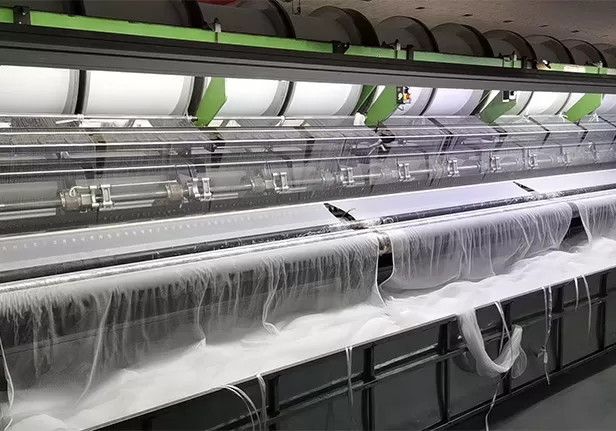
Warping and Knitting: High-speed Karl Mayer warp-knitting machines convert yarn packages into continuous fabric webs. Constant tension control during this phase is required to eliminate structural weak points.
Dyeing and Heat-Setting: The raw fabric is dyed to the specified color and passed through a stenter frame. This heat treatment stabilizes the width and length of the mesh, ensuring it does not shrink or lose shape during subsequent washing.
Insecticide Application: For coated nets, the stabilized fabric passes through an impregnation bath, followed by controlled drying to cure the binder system.
Cutting, Stitching, and Assembly: Automated cutting tables slice the fabric into panels based on specific dimensional patterns. Skilled operators then stitch the panels using heavy-duty industrial sewing machines, reinforcing the seams and corner loops where physical stress is highest during suspension.
Quality control protocols must be active at every stage. Random samples from each lot undergo physical testing for burst strength, shrinkage, and flammability, alongside chemical testing for active ingredient retention. A reliable manufacturer will document these results in comprehensive batch records, providing full traceability from raw materials to the dispatched container.
Customization Options for Regional Distribution
Vector control requirements vary significantly by geographic region, cultural preference, and environmental conditions. A versatile YAHE mosquito net manufacturer must offer extensive customization capabilities to address these localized variables without compromising the structural integrity of the final product.
Dimensional variations represent the most common customization request. Standard rectangular nets are widely utilized in structured residential environments due to their efficient space utilization and ease of suspension from four corner points. However, in regions where sleeping arrangements are more fluid or temporary, conical (circular) nets suspended from a single central point are often preferred due to their rapid installation profile.
Beyond physical geometry, color selection plays a major role in user acceptance. In some territories, dark blue or green nets are favored because they do not show dust and dirt easily, whereas other communities prefer white nets as they make it easier to spot resting insects. Providing options for reinforced borders (denier reinforcement along the lower skirt of the net) is also highly advantageous, as this lower section is subjected to the highest friction when tucked under mattresses or sleeping mats.

Ensuring Compliance with Regulatory Frameworks
Procuring insecticidal netting for public health interventions requires compliance with international regulatory frameworks. Organizations such as the World Health Organization (WHO) Prequalification Team (RPQ) maintain rigorous evaluation protocols for vector control products. A reputable YAHE mosquito net manufacturer operates in alignment with these international guidelines to ensure safety, efficacy, and quality.
ISO 9001 certification forms the baseline for factory quality management systems, indicating that the facility operates under documented, repeatable processes. Furthermore, compliance with environmental and chemical safety standards, such as OEKO-TEX Standard 100, confirms that the auxiliary chemicals and dyes used during the manufacturing process do not contain harmful levels of toxic substances, making the nets safe for close, long-term contact with infants and pregnant women.
When reviewing potential partners, procurement officers should request comprehensive documentation, including independent laboratory testing reports verifying wash resistance, biological efficacy against target vector strains, and chemical residue profiles. This transparency is the hallmark of an authoritative manufacturing partner.
Frequently Asked Questions
Q1: What is the standard lifespan of an insecticidal net produced by a YAHE mosquito net manufacturer under field conditions?
A1: An engineered Long-Lasting Insecticidal Net (LLIN) is designed to maintain biological efficacy for a minimum of three years of continuous use, which equates to surviving at least 20 standardized washes under field conditions while retaining sufficient active ingredient levels to knock down and kill mosquitoes.
Q2: How does Yamei ensure the uniform distribution of insecticides across the netting material?
A2: Uniformity is achieved through computerized dosing systems during the impregnation phase for polyester, or through homogeneous extrusion blending for polyethylene. Regular batch testing using High-Performance Liquid Chromatography (HPLC) verifies that the active ingredient is evenly distributed across both the warp and weft of the fabric.
Q3: Why is denier selection important when planning a bulk procurement of protective nets?
A3: Denier measures the linear mass density of the yarn. A 75D net is lighter and more cost-effective, making it suitable for standard indoor settings. A 100D or 150D net offers significantly higher physical strength and tear resistance, which is recommended for rugged conditions, military deployments, or humanitarian emergency relief camps.
Q4: Can these nets be customized with flame-retardant additives?
A4: Yes, flame-retardant properties can be incorporated into the polymer masterbatch or applied during the finishing phase to meet local fire safety regulations, which is highly recommended for high-density shelter environments and humanitarian relief operations.
Q5: What are the packaging requirements for long-distance international shipment of these nets?
A5: To prevent chemical degradation from moisture and UV exposure during transport, nets are individually sealed in compressed, high-density polyethylene bags. These individual packs are then packed into pressurized bales or heavy-duty cartons to optimize container loading and protect the product during overland transit.
Initiate a Procurement Consultation
Selecting the appropriate textile specifications and chemical treatments for large-scale mosquito net distribution requires careful planning and manufacturing alignment. Yamei provides tailored manufacturing services to meet the precise requirements of your public health initiatives, commercial distribution networks, or humanitarian programs. To request product samples, detailed chemical specification sheets, or a formal quotation for bulk production, please contact our international supply department with your specific project details. Our engineering and sales teams are prepared to assist you in developing high-performance barrier solutions that meet your exact specifications.