Global procurement specialists, non-governmental organizations (NGOs), military supply chain officers, and commercial outdoor brands require highly reliable barrier protection to safeguard users against vector-borne diseases. In the international supply chain, identifying a capable outdoor bed net manufacturer involves evaluating material science, polymer durability, chemical treatments, and compliance with international standards. These specifications determine the longevity and efficiency of the finished product in demanding environments.
As a specialized producer in this field, Yamei works to address these complex requirements. By focusing on precise engineering and rigorous quality control, manufacturers can deliver barrier solutions that withstand harsh environmental exposure while maintaining breathability and comfort. This analysis explores the technical parameters, material configurations, and manufacturing processes that define high-tier outdoor protective netting.
Understanding Material Science in Outdoor Netting Production
The choice of polymer determines the physical properties of the finished net. Outdoor environments expose protective netting to intense ultraviolet (UV) radiation, humidity, abrasion, and mechanical stress. An outdoor bed net manufacturer must choose materials that balance physical weight with structural strength.
Polyester vs. Polyethylene: Tensile Strength and Durability
Polyester and polyethylene represent the two primary polymers utilized in contract manufacturing. Each material offers distinct advantages depending on the final application scenario:
Polyester (PES): Typically processed using multi-filament yarns, polyester offers a soft texture and excellent drapability. It is naturally resistant to stretching and shrinking, making it suitable for compact, lightweight camping nets and pop-up shelters. Polyester fibers maintain their shape under tension, which prevents the mesh from distorting over prolonged use.
Polyethylene (PE): Commonly processed as a mono-filament yarn, polyethylene provides superior mechanical strength and puncture resistance. It is highly resistant to moisture absorption and chemical degradation, making it the preferred material for long-lasting insecticidal nets (LLINs) deployed in rugged, long-term humanitarian or military installations.
Denier Ratings and Mesh Count Specifications
Denier (D) measures the mass in grams per 9,000 meters of yarn. This rating directly influences the weight and burst strength of the fabric. Commercial outdoor netting generally ranges from 75D to 150D:
75 Denier: Provides a lightweight, highly packable solution suitable for recreational backpacking where pack weight is a key metric.
100 to 110 Denier: Balances weight and durability, serving as the standard specification for public health campaigns and general-purpose military use.
150 Denier and Above: Reserved for heavy-duty applications where maximum resistance to tearing and abrasive wear is mandatory.
Mesh count, defined as the number of holes per square inch, is equally important. A standard count of 156 holes per square inch (approx. 25 holes per square centimeter) effectively blocks vector insects like Anopheles mosquitoes while facilitating adequate airflow. For regions with smaller biting insects, such as midges or no-see-ums, a higher mesh count of 225 to 325 holes per square inch is required, though this slightly reduces ventilation.
Meeting Regulatory Standards and Protective Treatments
Raw physical durability is only one aspect of performance. An outdoor bed net manufacturer must also integrate active protection technologies, particularly when fabricating nets for disease-endemic areas.
| Standard Parameter | Recreational/Camping Netting | Humanitarian/LLIN Specifications | Military-Grade Netting |
|---|---|---|---|
| Primary Polymer | Polyester (Multifilament) | Polyethylene (Monofilament) or PES | High-Tenacity Polyester/Nylon |
| Denier Range | 50D - 75D | 100D - 150D | 100D - 150D (Ripstop) |
| Mesh Density (Holes/sq in) | 156 to 225 | 156 | 156 to 300 (Sandfly proof) |
| Chemical Treatment | Optional (Permethrin) | Long-Lasting Insecticide (LLIN) | Permethrin (Wash-resistant coating) |
| Flame Retardancy | Optional (CPAI-84) | Not standard, dependent on project | Required (ISO 15025 / NFPA 701) |
Insecticide Incorporation and Coating Processes
For long-lasting insecticidal nets, the application of chemical barriers must be precise. Manufacturers utilize two primary methods of treatment:
One method involves factory-controlled coating, where insecticide (such as deltamethrin or alpha-cypermethrin) is bound to the polyester fibers using a specialized polymer resin. This surface binder allows a controlled, gradual release of the active ingredient over several years and through multiple wash cycles.
The second method is direct polymer incorporation, typically used with polyethylene. The insecticide is mixed directly into the polymer melt before extrusion. As the insecticide on the surface of the fiber degrades or washes away, fresh insecticide migrates from the core of the monofilament to the surface. This ensures uniform protection that can withstand up to 20 or more standardized washes, conforming to World Health Organization (WHO) prequalification standards.
Compliance with Global Safety Certifications
B2B purchasers must verify that the manufacturing facilities adhere to strict chemical and environmental standards. Compliance with OEKO-TEX® Standard 100 ensures that the textile products are free from harmful levels of toxic substances, making them safe for direct skin contact. Additionally, conformity to ISO 9001:2015 quality management systems ensures consistency across production runs, preventing variation in mesh dimensions and chemical concentration.
Key Challenges in Bulk Sourcing from an Outdoor Bed Net Manufacturer
B2B buyers face several operational and structural challenges when procuring large volumes of protective netting. Addressing these challenges requires selecting a manufacturing partner with transparent quality control protocols.
Inconsistent Mesh Uniformity and Burst Strength
Low-tier manufacturing facilities often utilize poorly calibrated warp-knitting machines. This leads to variations in hole sizes across the fabric roll. Larger holes compromise the barrier properties, allowing insects to penetrate. Conversely, blocked or irregular holes restrict airflow, causing discomfort to the user in humid environments. To prevent these issues, Yamei utilizes automated optical inspection systems during the knitting process to detect and mark defects in real time.
Burst strength is another vital parameter, measured via pneumatic or hydraulic methods (such as ISO 13938). If the yarn tension is unevenly distributed during knitting, the net will possess weak points susceptible to tearing when tensioned over support poles or cot corners.
Supply Chain Delays in High-Volume Custom Orders
Large-scale tenders—such as those issued by global health organizations or national defense departments—require millions of square meters of fabric delivered within tight timeframes. A manufacturer without internal extrusion and warp-knitting capabilities must rely on external yarn suppliers, exposing the project to raw material shortages. Vertical integration, from polymer compounding to final packaging, allows a reliable producer to control production schedules and mitigate supply chain bottlenecks.
Balancing Lightness with Mechanical Resistance
Recreational and tactical end-users demand minimal weight and pack volume. However, reducing the denier of the yarn to achieve lightness naturally decreases the tensile strength of the net. To resolve this, advanced manufacturers use high-tenacity yarns and specialized lock-stitch knitting patterns. This prevents runs or unraveling when the fabric is punctured, preserving the structural integrity of the net in remote field conditions.
How Yamei Addresses Custom Manufacturing Requirements
A capable partner must provide tailored solutions rather than standard, off-the-shelf products. Yamei focuses on addressing specific custom requirements for diverse business clienteles.
Advanced Knitting and Quality Control Protocols
Using computerized Raschel warp-knitting machines, Yamei produces netting with high dimensional stability. The resulting lock-stitch structure ensures that even if a single filament breaks, the adjacent loops do not unravel. Tension control systems during the weaving phase ensure that every square meter of fabric exhibits identical burst strength and elongation properties.
Chemical verification is conducted in on-site testing laboratories. High-Performance Liquid Chromatography (HPLC) testing is performed to verify that the concentration of active insecticide remains consistent across all production batches, meeting the precise target ranges specified in client contract documents.
Customized Sizing and Frame Integration for Diverse Applications
B2B buyers frequently require specific dimensions to fit custom military cots, pop-up camping tents, or specialized outdoor gazebos. Yamei offers comprehensive OEM and ODM services, including:
Reinforced Border Seams: Heavy-duty Oxford cloth or PVC-coated canvas is stitched along the bottom and corners to prevent abrasion from rough ground or metal bed frames.
Suspension Attachment Points: Double-stitched webbing loops and brass or polymer grommets are integrated to distribute suspension forces evenly.
Integrated Frame Systems: Lightweight fiberglass, aluminum, or spring-steel wire frames can be integrated directly into the design for self-assembling, pop-up structures.
Application Scenarios for High-Grade Outdoor Bed Nets
The deployment of outdoor protective netting spans multiple distinct sectors, each with unique operational demands.
Humanitarian Aid and Disaster Relief
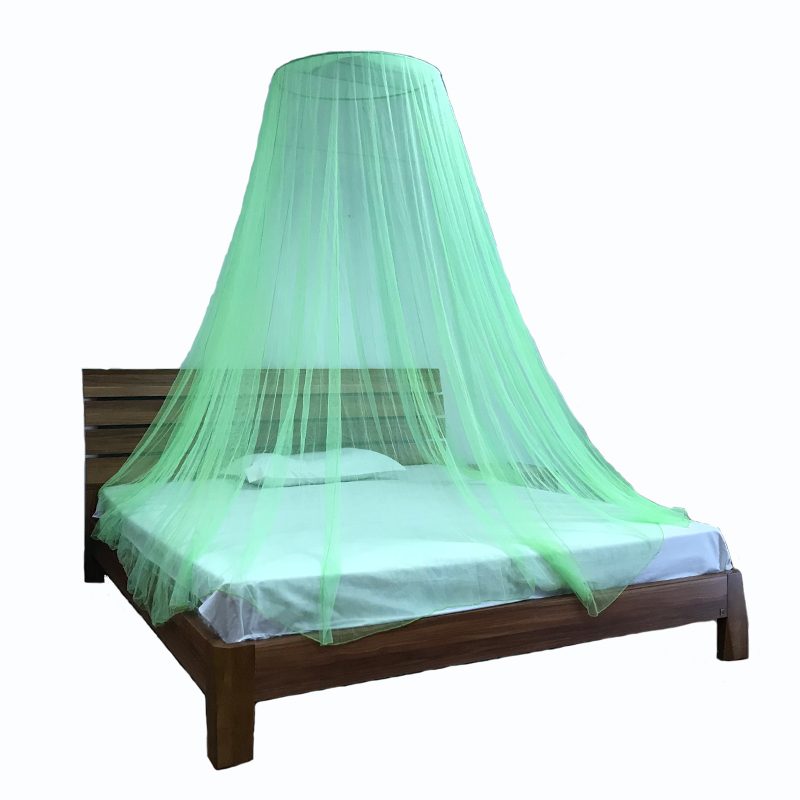
In post-disaster zones or refugee camps, temporary shelters are frequently set up in areas with poor sanitation and standing water, creating breeding grounds for disease-carrying mosquitoes. Netting deployed in these scenarios must be easy to hang, highly durable, and chemically treated to reduce vector populations. These nets are typically designed with simple rectangular or bell-shaped configurations to fit over standard humanitarian folding cots or ground mats.
Military and Tactical Deployments
Military personnel operating in jungle, forest, or desert environments require netting that conforms to camouflage standards. Beyond color specifications (such as olive drab, coyote brown, or specific digital camo patterns), tactical netting must often feature infrared reflective (IRR) coatings to minimize visibility under night-vision surveillance. The netting must also remain silent when handled and fold down into compact, durable pouches compatible with standard-issue field packs.
Commercial Recreation and Premium Camping Brands
Outdoor gear retailers require aesthetic refinement alongside functional performance. For these brands, the netting must feature clean, double-needle stitching, smooth zipper closures, and lightweight packaging. The product design must prioritize ease of setup, often incorporating flexible pole sleeves and color-coded attachment points. Manufacturers must provide customized retail-ready packaging, including compression sacks and detailed instruction inserts, to align with the branding of premium outdoor labels.
Evaluating Manufacturer Capabilities Beyond the Product
When establishing a long-term sourcing agreement, the operational capacity of the partner is just as important as the physical sample. A professional evaluation should consider several institutional capabilities:
Material Traceability: The manufacturer must provide clear documentation showing the origin of the polymer chips, yarn, and chemical additives used in production.
Eco-Friendly Manufacturing: Modern sourcing standards favor partners who implement waste-reduction protocols, recycle water used in dyeing processes, and utilize energy-efficient machinery.
Logistics and Regulatory Compliance: An experienced exporter should navigate complex customs procedures, handle international shipping documentation, and offer flexible shipping terms (FOB, CIF, DDP) to streamline the import process for the buyer.
Frequently Asked Questions
Q1: What is the standard lifespan of an insecticide-treated outdoor bed net?
A1: Under standard field conditions, a long-lasting insecticidal net (LLIN) manufactured through polymer incorporation or high-durability surface coating is designed to maintain its bio-efficacy for up to three years or through 20 standardized washes. The physical durability depends on the denier of the yarn and exposure to UV radiation.
Q2: Can the netting fabric be customized for fire retardancy?
A2: Yes. For military, commercial glamping, or public-use shelters, the polymer can be treated with flame-retardant additives during the extrusion process or coated during finishing. This treatment ensures compliance with international flammability standards such as CPAI-84 or NFPA 701.
Q3: What are the minimum order quantities (MOQ) for custom OEM orders?
A3: Because the setup of warp-knitting machines and custom chemical formulation requires substantial calibration, the minimum order quantity for custom dimensions, colors, or treatment specifications typically starts at 3,000 to 5,000 units, depending on the complexity of the design and the material requirements.
Q4: How does the manufacturer ensure mesh size consistency during mass production?
A4: High-quality production lines utilize real-time optical scanning systems installed directly on the warp-knitting machinery. These cameras detect any dropped stitches, broken filaments, or spacing irregularities immediately. The machinery halts or marks the roll to ensure defective fabric is excluded from the final assembly.
Q5: What quality certifications should an outdoor bed net manufacturer hold?
A5: A reputable manufacturer should hold ISO 9001:2015 for quality management systems and OEKO-TEX® Standard 100 for chemical safety. For public health supply chains, compliance with WHO prequalification guidelines and pesticide registration standards in the destination country is also required.
Initiate a Technical Sourcing Inquiry
Sourcing protective netting for commercial, military, or humanitarian distribution requires a partner capable of meeting precise specifications. Yamei provides advanced manufacturing services, offering customized denier options, specialized chemical treatments, and durable stitch patterns to meet your exact project requirements.
To request product samples, technical datasheets, or a detailed quotation for your upcoming project, please contact our B2B export department with your specific material requirements, desired dimensions, and projected order volume. Our engineering team will review your specifications to provide a comprehensive manufacturing proposal.