
The global demand for high-performance protective gear has led to strict requirements for outdoor equipment manufacturers. Within the protective bedding and shelter sectors, sourcing reliable insect barrier systems requires deep industrial knowledge. Brands and distributors often rely on specialized manufacturing partners to translate design concepts into market-ready products. This analysis examines the technical specifications, material selections, and chemical treatments involved in outdoor mosquito net OEM/ODM, providing procurement officers with the metrics needed to evaluate production partners like Yamei.
1. Material Engineering: Fiber Selection and Mesh Architecture
The foundation of any high-performance outdoor netting lies in the polymer selection. Manufacturers primarily utilize polyester (polyethylene terephthalate) or polyamide (nylon) monofilaments or multifilaments. Each material exhibits distinct behaviors under mechanical stress and environmental exposure.
Polyester is favored for outdoor applications due to its natural hydrophobic properties and resistance to ultraviolet (UV) degradation. It retains less than 1% moisture by weight, which prevents sag and structural weakening in high-humidity or rainy conditions. Polyamide offers higher tensile strength and abrasion resistance, but its hydrophilic nature makes it prone to stretching when wet. For tactical and heavy-duty expedition gear, blended fibers or specific coatings are applied to balance these attributes.
When specifying requirements to an outdoor mosquito net OEM/ODM partner, three primary physical metrics define the performance of the fabric:
Denier (D): This measure of linear mass density determines the weight and thickness of the individual threads. Standard outdoor netting ranges from 40D for lightweight backpacking setups to 150D for military-grade perimeter barriers. A higher denier increases puncture resistance but raises the total weight and reduces packability.
Mesh Count (Holes per Square Inch): The density of the weave governs both insect exclusion capabilities and ventilation efficiency. A standard insect net utilizes a mesh count of 225 to 300 holes per square inch, which effectively blocks common vectors like Anopheles and Aedes mosquitoes. For environments infested with biting midges or noseeums, a finer mesh of 400 to 600 holes per square inch is required, though this significantly restricts airflow.
Grams per Square Meter (GSM): This metric reflects the overall fabric density, combining thread thickness and weave tightness. Outdoor applications generally specify a GSM between 25 and 45 to maintain structural integrity without adding unnecessary load to portable gear systems.
Yamei manages these parameters through precise control of high-speed warping and knitting machinery, ensuring consistent pore size distribution across large production runs.
2. Chemical Impregnation and Vector Control Standards
For humanitarian procurement, military deployment, and high-risk endemic areas, physical barriers alone may not suffice. Long-Lasting Insecticidal Nets (LLIN) represent a specialized segment within the outdoor mosquito net OEM/ODM sector. Sourcing these products requires adherence to international chemical safety and efficacy protocols.
The impregnation process involves bonding synthetic pyrethroids, such as permethrin, deltamethrin, or alphacypermethrin, directly into or onto the polymer fibers. There are two primary industrial methods for achieving this:
In coating technologies, the insecticide is mixed with a polyurethane or acrylic binder and applied to the finished mesh fabric. This method is highly compatible with polyester fibers. The binder slowly releases the active ingredient over time. In incorporation technologies, the insecticide is compounded directly into the polymer chips prior to extrusion, a method typically reserved for polyethylene-based nets. This ensures the active ingredient is distributed evenly throughout the fiber matrix.
Evaluating an outdoor mosquito net OEM/ODM partner requires checking compliance with international wash-resistance standards. A standard LLIN must retain insecticidal efficacy for at least 20 standardized washes under laboratory conditions, as defined by World Health Organization (WHO) testing guidelines. Manufacturers must demonstrate that the active ingredient concentration remains within therapeutic levels (e.g., 55 mg/m² for deltamethrin or 1000 mg/m² for permethrin) while meeting human safety certifications such as OEKO-TEX Standard 100 and REACH compliance.
3. Structural Customization and Mechanical Design (ODM)
Modern outdoor shelters demand complex geometries that integrate seamlessly with existing camping setups, cot beds, hammocks, or vehicle-mounted awnings. Translating these diverse requirements into scalable designs is the core function of the ODM workflow.
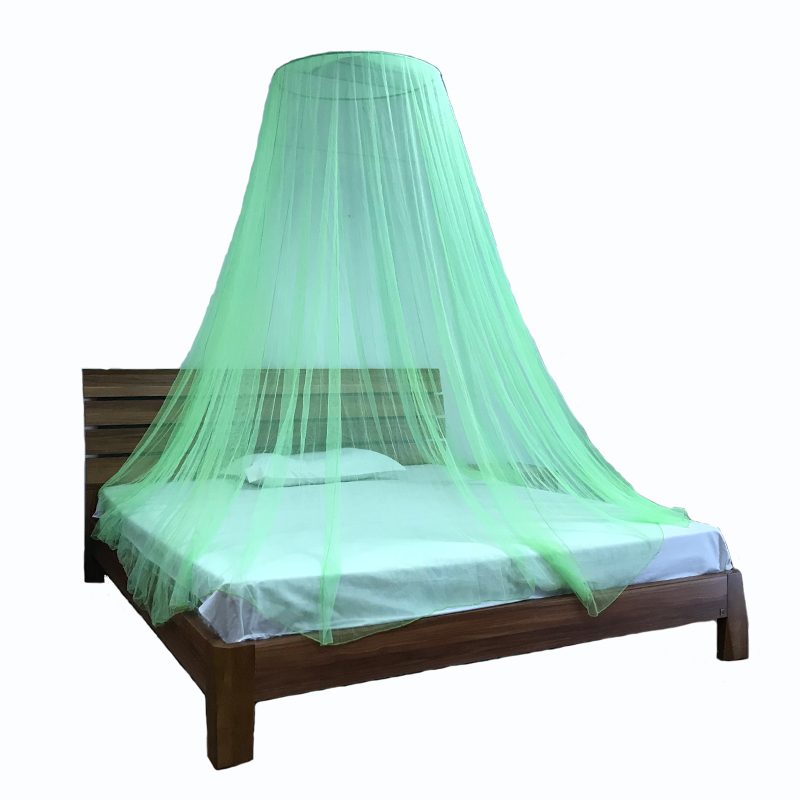
Structural stability in various wind loads is achieved by choosing the right support mechanisms. Pop-up designs utilize high-tensile spring steel loops or fiberglass rods that automatically deploy upon opening. Wedge and box configurations rely on reinforced suspension loops made of heavy-duty nylon webbing. For hanging nets, single-point top rings require balanced weight distribution to prevent the fabric from draping onto the sleeper's skin, which would compromise the physical barrier.
Entryways and closures represent common failure points in field conditions. Heavy-duty zippers, typically sizes #5 to #8 coil zippers with double-sided sliders, must be double-stitched and reinforced with bartack stitching at key stress points. Magnetic closure strips are increasingly integrated into ODM designs to allow hands-free entry and automatic sealing, particularly for vehicle-based or patio-style setups.
Ground flaps and borders require different material specifications than the main body. Manufacturers often sew a high-denier oxford polyester skirt (typically 150D to 300D) around the base of the net. This skirt serves multiple purposes: it protects the delicate mesh from ground abrasion, allows for dirt or rocks to be piled on to secure the seal, and prevents crawling insects from entering beneath the barrier.
4. Industrial Quality Control and Testing Protocols
To maintain brand reputation and minimize field failures, a structured quality control system must govern the entire manufacturing cycle. An established outdoor mosquito net OEM/ODM facility like Yamei implements standardized laboratory tests at multiple production phases.
Tensile strength testing, conducted according to ISO 13934 standards, measures the maximum force the mesh fabric can withstand before rupturing. This is particularly vital for tensioned structures like hammock bug nets. Bursting pressure tests use hydraulic or pneumatic pressure to evaluate the strength of the knit multidirectionally, simulating localized impacts from tree branches or camping gear.
Seam strength and dimensional stability are also verified. Seams are the most vulnerable parts of an outdoor net. Industrial sewing machines must maintain a consistent stitch density (typically 3 to 4 stitches per centimeter) using UV-resistant bonded polyester thread. Finished products undergo thermal stability testing to verify that the mesh does not shrink or lose elasticity when exposed to high summer temperatures during transport or storage inside vehicle cabins.
For treated nets, chemical analytical testing via Gas Chromatography-Mass Spectrometry (GC-MS) is performed on random batch samples to confirm the precise dosage of active ingredients, preventing both under-dosage (which leads to disease transmission risks) and over-dosage (which leads to skin irritation or regulatory rejection).

5. Supply Chain and B2B Procurement Management
Sourcing outdoor mosquito nets at scale requires an understanding of the production timeline, raw material price fluctuations, and global shipping standards. Raw materials, specifically polyester chips and chemical treatments, are subject to petroleum market volatility. Established manufacturers mitigate these risks through forward contracts and raw material stock buffers, ensuring stable pricing for long-term contract clients.
The standard OEM/ODM timeline follows a structured progression:
Specification Alignment: The buyer submits design blueprints, material requirements, and target price points. The manufacturer conducts a feasibility study and recommends adjustments to mesh density, sewing techniques, or hardware.
Prototyping: Initial physical samples are generated within 5 to 10 working days, depending on the availability of custom hardware or dyed-to-match fabric colors.
Compliance and Lab Verification: The prototype undergoes physical and chemical testing to ensure compliance with the target market's regulatory standards.
Mass Production: Upon sample approval, raw materials are allocated. Production line setup, automated fabric cutting, stitching, quality inspection, and packaging proceed in accordance with ISO 9001 management workflows.
Custom Branding and Packaging: Private label requirements are integrated during the final assembly phase. This includes custom hangtags, branded compression sacks, instruction manuals, and outer carton marking tailored to regional logistics requirements.
Yamei handles these supply chain components to provide global brands with consistent, large-scale production runs that arrive on schedule.
6. Common Questions Regarding Outdoor Mosquito Net Manufacturing
Q1: What is the minimum order quantity (MOQ) for custom outdoor
mosquito net OEM/ODM projects?
A1: MOQs depend on material
requirements and customization levels. For standard colors and standard mesh
configurations, MOQs typically start at 1,000 units. For fully customized
designs requiring unique fabric dyes, custom extrusion, or specialized chemical
treatments, the MOQ usually ranges from 3,000 to 5,000 units per batch.
Q2: How do you ensure the chemical treatments on the nets are safe
for long-term skin contact?
A2: All chemical finishes used in our
production processes comply with strict global safety standards. Our treated
nets undergo testing to meet OEKO-TEX Standard 100 requirements, ensuring the
absence of harmful levels of toxins or skin irritants. The active insecticidal
agents are bonded to the fibers to prevent excessive chemical migration onto
human skin.
Q3: Can your factory handle custom packaging and private label
printing for retail-ready distribution?
A3: Yes, we provide full
retail packaging solutions. This includes the production of branded compression
bags, customized hangtags, user manuals, and outer carton packaging designed to
meet retail-shelf and e-commerce distribution center specifications.
Q4: How does mesh size affect the weight and packability of a
portable backpacking net?
A4: Mesh size and thread denier are the
primary drivers of weight. A 40D noseeum mesh (approx. 600 holes/sq inch) is
heavier and less packable than a 20D ultra-light micro-mesh. During the ODM
phase, we analyze the balance between pack volume, weight limits, and target
insect sizes to match specific product categories.
Q5: What certifications should a buyer request from an outdoor
mosquito net OEM/ODM partner?
A5: Buyers should request ISO 9001
certification for quality management, third-party laboratory test reports (SGS
or Intertek) verifying tensile and bursting strength, and chemical safety
certificates such as REACH, RoHS, or OEKO-TEX reports for treated fabrics.
7. Commercial Collaboration and Custom Sourcing
Selecting a manufacturing partner involves evaluating production capacity, quality management systems, and technical design services. Yamei provides end-to-end support for custom outdoor mosquito net production, from initial material formulation to completed product packaging. Companies seeking reliable supply chains for commercial, tactical, or humanitarian programs are invited to contact our technical sales team. Detailed specifications, material samples, and cost estimates can be provided based on your specific requirements. Please submit your request for proposal, and our engineering department will contact you with a comprehensive analysis.