Vector control programs face serious challenges across global distribution networks. Mosquitoes continue to develop resistance to standard pyrethroid insecticides, forcing procurement teams to rethink their supply chains. Sourcing managers must now balance chemical efficacy, fabric durability, and strict budget constraints when managing high-volume tenders.
Whether you procure for humanitarian agencies, national health ministries, defense logistics, or commercial hospitality, buying large canopies requires rigorous engineering standards. At YAHE LN, we engineer long-lasting insecticidal nets (LLINs) and custom barrier systems designed to meet rigorous field demands and international compliance criteria.
This technical guide provides procurement officers and supply directors with the exact parameters needed to evaluate raw materials, select active ingredients, verify testing protocols, and cut freight costs on high-volume shipments.
The Shift in Global Procurement: Battling Pyrethroid Resistance
For over two decades, standard pyrethroid-only nets served as the frontline defense against vector-borne diseases like malaria, dengue, and lymphatic filariasis. However, widespread physiological resistance in Anopheles populations has reduced the bio-efficacy of legacy nets. Single-agent nets no longer provide the kill rates required to interrupt disease transmission in high-burden regions.
International agencies such as the Global Fund and UNICEF now prioritize next-generation nets. These formulations restore high mortality rates against resistant vectors by combining multiple modes of action:
Pyrethroid + PBO (Piperonyl Butoxide): PBO acts as a synergist. It inhibits the mosquito's metabolic enzymes (cytochrome P450s), preventing the insect from breaking down the pyrethroid and restoring chemical vulnerability.
Dual-Active Ingredient (Dual-AI) Nets: These nets incorporate two distinct adulticides, typically a pyrethroid paired with Chlorfenapyr or Pyriproxyfen. Chlorfenapyr disrupts cellular energy production in the mosquito mitochondria, an entirely different physiological pathway that bypasses standard resistance mechanisms.
When preparing tenders for any large mosquito net bulk contract, specifying the correct chemical class prevents field failure and ensures long-term protection for target populations.
High-Volume Application Scenarios for Large Netting
Large-format mosquito netting serves diverse operational environments. Each setting demands distinct physical profiles, mechanical strengths, and treatment protocols.
Disaster Relief and Humanitarian Shelters
Emergency response operations require multi-functional net canopies that integrate seamlessly into relief tents, temporary medical outposts, and emergency communal shelters. These nets must resist high-frequency handling, rapid deployment, and harsh environmental exposure without snagging or tearing.
Military Field Camps and Defense Logistics
Tactical field operations require heavy-duty box-style canopies compatible with standard-issue cots and field bunks. Neutral or tactical shades (such as olive drab, coyote tan, and foliage green) are standard. These nets often require simultaneous treatment for both vector control and strict flame-retardant standards.
Hospitality, Safari Lodges, and Commercial Glamping
Luxury resorts, safari operations, and high-end eco-lodges demand oversized canopies tailored for super king and emperor-size beds. These commercial applications prioritize aesthetics, soft drape, structural elegance, and high airflow. At the same time, they must remain fully functional barriers against nuisance pests and disease vectors.
Structural Architecture and Size Engineering
The structural geometry of a net directly dictates user compliance and mechanical lifespan. A net that contacts the sleeper's skin during the night defeats its own purpose, as mosquitoes can easily bite through standard mesh openings when fabric rests directly on the body.
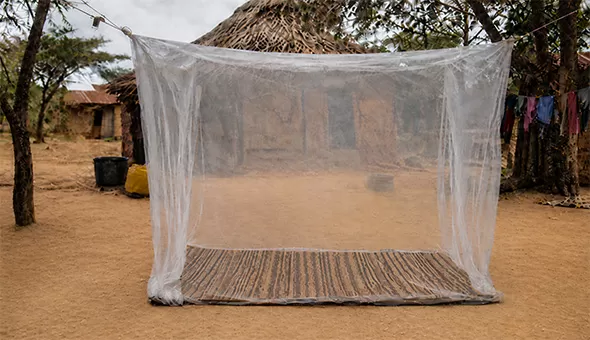
Rectangular (Box / Four-Poster) Canopies: The preferred choice for maximum interior volume. Vertical side walls keep netting away from the body. Six to eight reinforced suspension loops distribute mechanical tension evenly across overhead anchor points.
Conical (Single-Point Ring) Nets: Ideal for rapid deployment where overhead suspension points are limited. Large top rings (expanding from 65cm to 120cm in diameter) ensure the netting falls away from the bed surface rather than sloping inward sharply.
Wedge and Ridge Configurations: Lightweight profiles engineered for temporary field bunks, tactical bivouacs, and emergency deployable cots.
For any large mosquito net bulk project, pay close attention to structural reinforcement points. Critical failure zones occur at hanging loops, corner junctions, and lower floor borders. Quality manufacturing incorporates double-stitched overlapping seams and high-denier fabric patches under every hanging loop to resist sudden vertical loads.
Material Science: Selecting the Right Polymer and Yarn Weight
Selecting base yarn polymers involves balancing tensile strength, airflow, chemical retention, and unit cost. The three most common polymers each present clear operational tradeoffs.
Polyester (PES): Multifilament polyester provides exceptional soft drape, structural flexibility, and superior tactile comfort. It readily accepts polymer-binders for chemical treatments, making it the industry standard for high-end hospitality and large bed canopies.
High-Density Polyethylene (HDPE): Monofilament HDPE extrusions incorporate insecticide directly into the masterbatch polymer mix before extrusion. The chemical slowly migrates to the surface over time (slow-release technology), delivering high abrasive strength and resistance to physical punctures.
Polypropylene (PP): A lightweight monofilament alternative that provides rigid structural integrity and minimal water absorption, though less common in large-format indoor consumer markets.
Yarn Denier and Durability Ratings
Denier measures linear mass density in grams per 9,000 meters of yarn. Selecting the right denier determines whether the finished canopy survives long-term field use:
75 Denier: The lightweight, cost-effective standard for mass public distribution where shipping weight and unit economics are paramount. Best suited for controlled indoor residential settings.
100 Denier: The operational sweet spot. Delivers 40% higher bursting strength than 75D fabric with minimal weight penalty. Ideal for institutional housing, student hostels, and international NGO distributions.
150 Denier: Heavy-duty industrial grade. Engineered specifically for military operations, outdoor survival gear, and high-turnover rental accommodations where fabric faces severe abrasion.
At YAHE LN, extrusion and knitting lines run tight quality checks to guarantee consistent filament diameter. This eliminates thin spots across wide-width fabric panels.
Mesh Density: Balancing Protection Against Ventilation
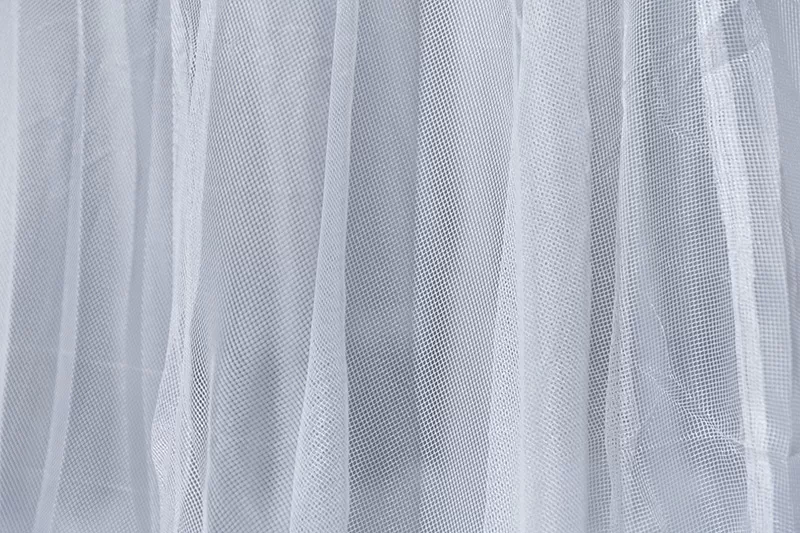
Standard WHO-recommended vector netting requires a mesh density of ≥156 holes per square inch (approx. 24 holes/cm²). This grid size blocks Anopheles, Aedes, and Culex mosquitoes while maintaining natural air circulation in tropical environments.
For operations in coastal, riverine, or marshland areas infested with biting midges, sandflies, or blackflies, procurement teams should specify ultra-fine "No-See-Um" mesh netting (≥300 to 600 holes per square inch). These dense micro-meshes prevent midges from squeezing through, though they slightly reduce passive airflow.
Chemical Formulations, Safety, and Compliance Standards
Insecticide-treated nets rely on advanced surface binding to remain active through repeated wash cycles. Institutional procurement teams should verify compliance against established quality protocols before approving batch production.
Wash Retention (LLIN Standard): High-grade LLINs must retain at least 85% of their chemical efficacy after 20 to 25 standardized laboratory washes (following WHO wash protocol guidelines).
WHO Prequalification (WHO-PQ): Confirms that the product formulation, field efficacy, toxicological profile, and manufacturing plant meet strict United Nations standards for international public health procurement.
OEKO-TEX Standard 100 Certification: Guarantees that yarn binders, dyes, and finishing agents are free from harmful levels of heavy metals, formaldehyde, and skin-sensitizing aromatic amines.
Flammability Compliance: Large nets deployed in institutional settings or hospitality must satisfy flame retardancy standards such as CPAI-84 or NFPA 701, preventing rapid flame spread in closed living quarters.
Chemical batch verification relies on CIPAC (Collaborative International Pesticides Analytical Council) testing methods. These tests confirm active ingredient concentration and uniform wash resistance across all production lots.
Logistics Engineering: Slashing Freight on High-Volume Orders
Large mosquito netting creates a common freight challenge: low weight combined with high bulk volume. Shipping uncompressed, boxed mosquito nets means paying primarily for empty air inside cargo containers. Smart packaging drastically reduces landed cost per unit.
Standard master cartons hold limited net volumes because fluffy knitted meshes trap air inside the packaging. Modern production facilities solve this by using automated hydraulic compression equipment:
High-Density Compressed Bales: Industrial hydraulic presses compress folded nets under massive pressure into high-density bales wrapped in heavy-gauge polypropylene woven sheeting with reinforced strapping bands.
Container Loading Capacity: Switching from standard loose carton packing to dense baling increases the net count in a 40-foot High Cube (40HQ) container by 40% to 60%. A single 40HQ container can carry between 35,000 and 80,000 finished nets, depending on dimensions, denier, and ring hardware.
Protective Barrier Packaging: To prevent insecticide breakdown during long ocean transits and multi-year warehouse storage, nets require heavy-duty, anti-UV, moisture-proof inner liners. This protective wrap preserves a 3- to 5-year operational shelf life even in hot tropical ports.
This volume reduction lowers ocean freight expenses per unit, directly reducing landed costs for institutional buyers.
How to Draft a High-Precision B2B Mosquito Net RFQ
To avoid production delays, sampling errors, and misaligned quotes, institutional buyers should provide clear technical requirements in their initial Request for Quotation (RFQ). Make sure your RFQ includes these essential specifications:
Target Dimensions: Length × Width × Height ± Base Circumference (e.g., 200cm × 180cm × 150cm for standard King Box; 65cm ring × 250cm height × 1250cm base for Conical).
Yarn Specs: Base polymer (Polyester/HDPE), Yarn Denier (75D/100D/150D), Filament type (Multifilament vs. Monofilament).
Mesh Count: Holes per square inch (e.g., standard 156 mesh vs. 300+ ultra-fine No-See-Um mesh).
Chemical Treatment: Untreated, Pyrethroid LLIN, Pyrethroid + PBO synergist, or Dual-AI Chlorfenapyr formulation.
Compliance Targets: Required testing reports (WHO-PQ dossier, OEKO-TEX Standard 100, CPAI-84 fire rating, CIPAC chemical assays).
Packaging Configuration: Individual retail OPP bag with custom insert cards, vacuum packs, or bulk industrial compressed bales (specify units per bale, e.g., 50 or 100 units/bale).
Order Quantities: Tiered volume schedules (e.g., initial 5,000-unit pilot run scaling to full 20GP or 40HQ container quantities).
Clear technical details allow factories to quickly assess yarn extrusion capacity, schedule knitting line time, mix chemical formulations accurately, and return precise tiered pricing.
Frequently Asked Questions (FAQ)
Q1: What is the difference between standard LLINs and Dual-Active
Ingredient (Dual-AI) mosquito nets?
A1: Standard
LLINs use a single pyrethroid insecticide (such as Deltamethrin, Permethrin, or
Alpha-cypermethrin) to knock down and kill mosquitoes. Dual-AI nets combine a
pyrethroid with a secondary compound—such as Chlorfenapyr (a pyrrole that
disrupts insect energy production) or PBO (a metabolic synergist). Dual-AI
formulations overcome chemical resistance in local mosquito populations,
ensuring high kill rates where standard nets fail.
Q2: Why does denier matter when placing a large mosquito net bulk
order?
A2: Denier indicates the thickness and
weight of the yarn filament. A 75D net is lightweight, compact, and
cost-effective, but more prone to physical tearing if snagged. A 100D or 150D
net provides higher tensile and bursting strength, withstanding heavy abrasive
wear in military, disaster response, and institutional applications. Choosing
the correct denier balances product lifespan against budget and freight
volume.
Q3: How many large-format mosquito nets fit into a standard 40HQ
container?
A3: Load volume depends on net
dimensions, denier, and packaging method. When packed in traditional cardboard
boxes, a 40HQ container holds roughly 20,000 to 28,000 large bed nets. Using
high-density hydraulic compressed baling increases container capacity to between
40,000 and 70,000 units. This packing method cuts unit freight costs by up to
50%.
Q4: Can treated mosquito nets be washed without losing their
protective insecticidal properties?
A4: Yes,
certified LLINs incorporate special polymer resin binders or use chemical
extrusion techniques that slowly release active agents over time. These nets
maintain their protective efficacy through at least 20 to 25 standard washes
under WHO test protocols, retaining over 85% knockdown and kill rates throughout
their 3-year operational life.
Q5: Can factory production lines customize net dimensions, hanging
systems, and institutional branding?
A5: Yes.
Direct manufacturers can build custom rectangular, conical, and multi-peak
canopy designs to fit any bed, cot, or field tent dimension. Facilities can also
reinforce hanging points with high-strength webbing, add fire-retardant
finishes, customize fabric borders, and supply OEM packaging complete with
custom labels, instructional inserts, and barcoded cartons.
Build Your Direct Factory Supply Chain with YAHE LN
Procuring functional, long-lasting barrier netting requires strict adherence to raw material standards, chemical engineering, and logistics planning. Working directly with an experienced manufacturing partner ensures your orders meet global health standards while keeping freight budgets under control.
YAHE LN delivers full-scale manufacturing, automated knitting, precision chemical treatment, and custom OEM/ODM packaging for international organizations, defense agencies, and commercial brands worldwide. Whether you need standard 75D relief nets or custom heavy-duty 150D canopies, our team ensures on-time production, reliable quality, and comprehensive technical compliance.
Contact our technical sales engineers today to discuss your tender requirements, request factory samples, or receive a formal tiered price quotation for your next large mosquito net bulk order.
Direct Inquiries: Contact the YAHE LN B2B Procurement Desk at info@fjyamei.com or submit your technical specifications through our online portal to get a detailed production schedule within 24 hours.