Public health agencies, non-governmental organizations, and national ministry procurement departments facing persistent vector-borne disease challenges require durable, highly bio-effective control tools. Long-Lasting Insecticidal Nets (LLINs) remain the primary defense mechanism against disease vectors in endemic regions, accounting for over two-thirds of vector control interventions worldwide. Partnering with a qualified malaria mosquito net supplier China enables institutional buyers to secure scalable manufacturing capacity, rigorous chemical consistency, and strict adherence to international health standards. Manufacturers like Yamei operate integrated textile and chemical processing facilities designed to deliver robust netting solutions tailored for large-scale tender allocations and customized regional health programs.
Procurement decisions for disease control initiatives rely on long-term product viability, chemical stability, and structural resistance to physical wear. Understanding the underlying material science, polymer extrusion techniques, and active ingredient binding methods is required when evaluating production partners. China has established an integrated industrial framework for synthetic textile production, allowing qualified manufacturers to manage every phase of LLIN creation from raw resin processing to final packaging. This vertical integration translates into shortened lead times and enhanced quality control across the entire production pipeline.
Chemical Polymer Integration and Active Ingredient Binding Mechanisms
The longevity of an insecticidal net depends entirely on how active chemical agents are bound within or applied onto the synthetic matrix. Modern LLIN manufacturing uses specialized chemical application methods that prevent rapid degradation from washing, solar radiation, and mechanical handling.
Polymer Matrix Incorporation vs. Binding Resin Systems
High-density polyethylene (HDPE) netting utilizes a masterbatch incorporation method where pyrethroid insecticides are blended directly into the molten polymer prior to fiber extrusion. As the active ingredient gradually migrates to the filament surface over time, it replenishes the surface concentration lost through washing or daily handling. This continuous regeneration mechanism allows the netting to maintain bio-efficacy over a minimum of 20 standardized wash cycles without requiring re-treatment.
Polyester (polyethylene terephthalate, PET) netting employs a specialized polymer coating system utilizing a durable binding agent. The active ingredient is bound within a resin matrix that adheres uniformly to the multi-filament polyester yarn. Precise temperature control during the curing process ensures that the active chemical remains structurally stable without suffering thermal decomposition. Yamei utilizes automated chemical dosing platforms to ensure batch-to-batch chemical uniform distribution within a tight tolerance of less than 5% variance.
Pyrethroid Dosages and Bio-Efficacy Standards
Selecting appropriate active pharmaceutical ingredients requires strict adherence to international dosage parameters. Commonly specified active substances include:
Alphacypermethrin: Targeted at concentrations ranging between 3 to 6 g/kg depending on the underlying fabric denier and material type.
Deltamethrin: Formulated precisely between 1.4 to 1.8 g/kg for polyester fabrics to yield rapid knock-down capabilities.
Permethrin: Utilized in specific dual-active or legacy formulations requiring higher target concentrations around 20 g/kg.
Automated chemical injection systems guarantee that field-deployed nets consistently meet WHO cone bioassay standards, achieving vector mortality rates exceeding 80% and knock-down rates above 95% across extended usage trials.
Fabric Engineering and Physical Netting Specifications
While chemical potency deters and neutralizes vectors, physical netting specs dictate mechanical resistance against tearing, snagging, and daily wear in rural environments.
Filament Denier Selection and Bursting Strength Dynamics
Denier measures the linear mass density of the yarn fibers, directly correlating with fabric weight and burst resistance. Choosing the appropriate denier involves balancing structural strength against unit cost and weight restrictions for transport:
75 Denier: Lightweight multi-filament polyester yarn used primarily where high breathability and lower pack weight are prioritized. Minimum bursting strength ranges around 220 kPa.
100 Denier: Standard performance choice offering a practical equilibrium between physical endurance and cost structure. Bursting strength typically reaches or exceeds 250 kPa for PET and 350 kPa for HDPE.
150 Denier: Heavy-duty construction designed for rugged field conditions, high humidity, and intensive daily handling. HDPE mono-filament netting at 150 denier exhibits bursting strengths exceeding 400 to 450 kPa.
Mesh Density and Ventilation Balancing
The balance between vector exclusion and ventilation requires strict control over hole density. International standard specifications dictate a minimum hole count of 156 holes per square inch (equivalent to 24 holes per square centimeter). This mesh structure blocks entry by Anopheles mosquito species while permitting adequate ambient airflow, which is imperative for compliance and comfort in warm, humid regions.
Specialized applications may specify fine-mesh variations exceeding 200 holes per square inch to prevent intrusion by smaller secondary vector species, such as sandflies or midges. High-speed warp knitting machinery guarantees consistent loop geometry, preventing mesh distortion during washing or hanging tension.
Evaluating a Malaria Mosquito Net Supplier China for Scale Procurement
Global fund procurement mechanisms mandate strict adherence to international quality management systems. Choosing an audited malaria mosquito net supplier China ensures continuous raw material access alongside fully traceable quality audits. Production facilities operate under ISO 9001 and ISO 13485 frameworks to maintain continuous monitoring across all manufacturing stages.
WHO Prequalification Protocols and Facility Audits
Prequalification evaluates not only finished product performance but also manufacturing process control, raw material traceability, and environmental management systems. Qualified suppliers undergo regular facility audits to verify that active chemical storage, waste treatment, and batch logging protocols align with global health standards. Digital logging systems track each production lot from raw polymer pellet receipt to final container loading, enabling complete backward traceability within 48 hours.
Chromatographic Testing and Wash Retention Analysis
Quality assurance includes chemical assay verification conducted at multi-stage production checkpoints. Internal laboratory analysis utilizes High-Performance Liquid Chromatography (HPLC) to measure exact active ingredient concentration:
Raw Material Verification: Assessing chemical purity before introduction into extrusion or coating lines.
Post-Treatment Assay: Quantifying target chemical loading on freshly coated or extruded netting batches.
Wash Retention Testing: Subjecting sample swatches to 5, 10, and 20 standardized wash cycles followed by HPLC quantification to track chemical retention curves.
These analytical steps verify that products leaving the factory conform strictly to institutional contract requirements, avoiding chemical off-spec variances during destination inspection at discharge ports.
Supply Chain Resilience and Sourcing Capabilities
Global public health supply chains demand reliable production schedules and raw material availability. China's mature chemical manufacturing sector provides continuous access to pyrethroid active ingredients, polymer additives, and base resins, insulating production timelines from regional material shortages.
Raw Material Integration and Vertical Production Synergies
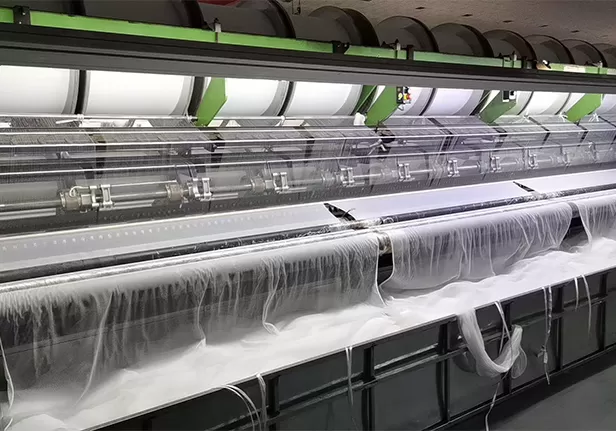
Operating within centralized industrial clusters allows manufacturers to obtain high-purity virgin PET and HDPE resins with minimal lead time. Avoiding recycled polymers prevents structural flaws and variable melting points that compromise fiber tensile strength and chemical distribution. Automated extrusion lines melt and form continuous filaments under monitored thermal conditions, yielding uniform yarn diameter prior to weaving.
Localized raw material access provides predictable lead times even during high-volume demand cycles typical of major national tender distributions. Maintaining high continuous throughput limits lead-time variances, allowing institutional buyers to schedule distribution campaigns, port clearances, and field deployments with operational precision.
High-Density Packaging and Container Volume Utilization
Ocean freight and inland transportation costs significantly affect overall program budgets. Factory-floor compression systems reduce the bulk cubic volume of finished goods, allowing procurement officers to maximize container capacity:
Individual Unit Packaging: Nets are wrapped in sealed polyethylene bags containing clear pictogram instruction sheets, batch numbers, and tracking barcodes.
Compressed Bale Packing: Individual units are packed into high-density bale configurations (typically 40, 50, or 100 nets per bale) using hydraulic presses and heavy-duty woven polypropylene outer wraps.
Container Loading Capacity: Optimized bale dimensions allow a standard 40-foot High Cube (40HC) ocean container to hold up to 40,000 to 42,000 units of 100D rectangular nets, driving down per-unit shipping costs.
Procurement Evaluation Criteria and Lifecycle Cost Analysis
Procurement decisions driven solely by initial unit price frequently result in higher overall program costs when accounting for replacement frequency, distribution logistics, and net durability. Evaluating suppliers requires analyzing the total cost of ownership across the intended deployment cycle.
Total Cost of Ownership vs. Initial Unit Price
A lower-priced net that exhibits accelerated physical tearing or rapid chemical loss requires earlier replacement, doubling the secondary distribution and administrative costs for field agencies. Field data gathered by Yamei demonstrates high fabric retention across extended deployment cycles, supporting a longer median field lifespan compared to non-standardized alternatives. This durability advantage translates into lower annualized costs per person protected, allowing health budgets to stretch further over multi-year funding cycles.
Customization Protocols for Regional Deployment
Vector control initiatives often require unique product configurations dependent on local housing structures, bed dimensions, and environmental conditions. Program managers can specify several custom operational parameters:
Shape and Geometry: Rectangular configurations for traditional bed frames; conical single-point suspension designs for rapid setup in temporary shelters.
Dimensions: Standard sizes ranging from Single (W100 x L190 x H150 cm) to Family/King (W190 x L180 x H150 cm), with custom length or height modifications.
Border Reinforcement: Integration of double-stitched polyethylene skirt bands along the bottom edge to prevent tearing when tucked under sleeping mats.
Color Customization: Standard white, light blue, or green shades dyed using UV-stable colorants that do not interact negatively with active chemical ingredients.
Frequently Asked Questions
Q1: What is the primary operational difference between HDPE and
Polyester insecticidal nets?
A1: High-Density Polyethylene (HDPE)
nets feature active ingredients incorporated directly into the mono-filament
polymer matrix during extrusion, offering high mechanical strength and tear
resistance. Polyester (PET) nets use multi-filament yarn coated with a chemical
binder resin, yielding a softer hand-feel, higher initial flexibility, and lower
overall weight for equivalent denier ratings.
Q2: How is the wash resistance of long-lasting insecticidal nets
evaluated during quality control?
A2: Samples are subjected to
standardized laboratory washing procedures defined by WHO guidelines. Samples
are washed, rinsed, dried, and stored at controlled ambient temperatures to
allow chemical migration back to the surface. Bio-efficacy (via mosquito
knock-down and mortality cone tests) and active ingredient concentration (via
HPLC assay) are measured after 5, 10, and 20 wash cycles to verify
compliance.
Q3: What documentation should procurement officers request to verify
manufacturing quality?
A3: Procurement teams should request full ISO
9001 and ISO 13485 quality management certificates, recent third-party
laboratory HPLC test reports for active ingredient concentration, wash-retention
certificates following 20 standard washes, and complete batch traceability logs
covering raw resin to finished bale packaging.
Q4: Why is precise active ingredient concentration monitoring
necessary during manufacturing?
A4: Under-dosing leads to sub-lethal
chemical exposure, which reduces vector control efficacy and accelerates
insecticide resistance among mosquito populations. Over-dosing increases
procurement costs unnecessarily and may lead to regulatory compliance failures
during port-of-entry chemical assays.
Q5: What payment structures and delivery lead times are standard for
institutional orders?
A5: Standard production lead times range from
45 to 60 days following specification sign-off and artwork approval for orders
between 500,000 and 1,000,000 units. Payment terms typically involve a deposit
via wire transfer to initiate production, with the remaining balance settled
against bill of lading presentation or through irrevocable letters of
credit.
Initiate Procurement and Specification Consultations
Securing high-performance vector control products requires direct engagement with an established manufacturing partner. Program directors, institutional buyers, and tender coordinators are invited to submit an inquiry to an experienced malaria mosquito net supplier China to receive custom proposals, request HPLC test reports, order physical swatches, or review detailed manufacturing schedules for upcoming distribution campaigns.