
Sourcing long-lasting insecticidal nets (LLINs) for large-scale distribution across Sub-Saharan regions demands strict compliance with material science, active ingredient incorporation, and international freight parameters. Public health organizations, government agencies, and commercial distributors require bed nets that withstand severe environmental exposure while delivering reliable vector control. Partnering with a specialized export Africa mosquito net factory ensures that production processes conform to global public health standards, precise denier specifications, and rigorous chemical wash-resistance benchmarks.

Polymer Engineering and Yarn Selection for Tropical Vector Control
The operational lifespan of a bed net depends heavily on raw material composition. Manufacturers primarily utilize two synthetic polymers: High-Density Polyethylene (HDPE) and Polyester (PET). Each material offers distinct physical behaviors during long-term field deployment.
High-Density Polyethylene (HDPE): Extruded as monofilament yarn, HDPE yields exceptional tear resistance and mechanical strength. Monofilament construction creates a rigid mesh matrix that maintains structural integrity even after multiple wash cycles or accidental punctures. HDPE nets typically utilize 100 to 150 denier yarns.
Polyester (PET): Produced as multifilament yarn, polyester provides a softer tactile feel and superior flexibility. Multifilament structures are commonly produced in 75 or 100 denier specifications. While softer, polyester fibers rely on specialized surface-coating treatments to lock active chemical agents into the polymer matrix.
Mesh density represents another decisive parameter. International public health specifications generally require a minimum mesh count of 156 holes per square inch (25 holes per square centimeter). This specific geometry creates an effective mechanical barrier against Anopheles mosquitoes while allowing adequate air airflow in humid tropical climates.
Active Ingredient Impregnation and Wash-Retention Mechanics
A functional LLIN must do more than physically block insects; it must maintain active chemical defense over a minimum three-year operational lifespan. Pyrethroid insecticides, including Deltamethrin, Alpha-Cypermethrin, and Permethrin, remain the primary active substances used in vector control products.
At Yamei, active ingredients are integrated directly into the molten polymer during the masterbatch extrusion phase for polyethylene products, or bound via continuous coating technology for polyester fabrics. Direct incorporation creates an internal chemical reservoir within the fiber core. As active molecules on the yarn surface are gradually worn away by abrasion or washing, internal molecules migrate outward to restore surface protection.
To verify this migration mechanism, standardized wash-resistance protocols subject the fabric to up to 20 consecutive laboratory washes. Key chemical metrics evaluate:
Knockdown Efficiency: The percentage of test vectors incapacitated within 60 minutes of contact.
24-Hour Mortality Rate: The percentage of vectors killed 24 hours post-exposure, which must consistently exceed 80% under standard WHO cone bioassay conditions.
Active Ingredient Retention: High-Performance Liquid Chromatography (HPLC) testing measures remaining chemical density (mg/m²) to verify migration equilibrium.
Manufacturing Processes and Quality Assurance Frameworks
Operating a high-capacity export Africa mosquito net factory requires rigorous quality control across every stage of processing, from raw resin handling to final conversion.
1. Extrusion and Yarn Spinning
Polymer chips are melted under precise temperature controls to prevent chemical degradation. Active ingredient masterbatches are metered into the extruder using volumetric feeders to guarantee accurate dosing across all production batches.
2. Warp Knitting
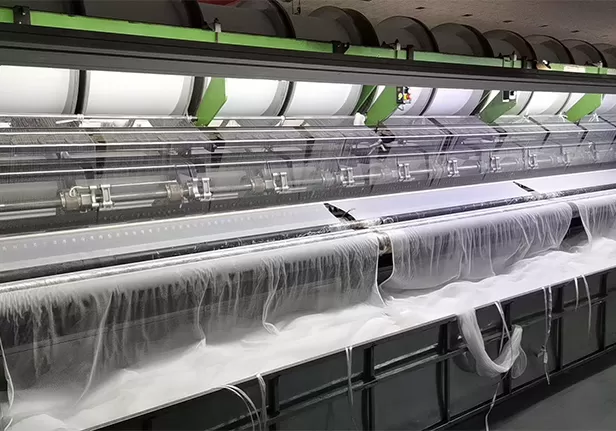
Extruded monofilament or multifilament yarns are processed on high-speed warp knitting machines. Machine operators monitor tension settings to prevent drop-stitches, uneven hole spacing, or structural weaknesses across the fabric roll.
3. Stenter Heat-Setting and Coating
Knitted fabric passes through hot-air stenter frames to stabilize dimensional tolerances. For polyester fabrics, pyrethroid formulations and resin binders are applied in a continuous dip-coating process, followed by controlled thermal curing to bond the chemical layer to the yarn surface.
4. Cutting, Hemming, and Assembly
Automated cutting tables slice fabric rolls into specified net dimensions. Industrial sewing teams finish edges with reinforced double-stitch hems. Skirt reinforcements—often made from heavy-duty polyethylene sheeting along the bottom 25 to 30 centimeters—are attached to protect against physical tearing caused by bed frames or floor contact.
Facilities like Yamei maintain cleanroom sampling practices where finished goods undergo physical burst testing using hydraulic diaphragm equipment (ISO 13938-1 standard) to confirm burst strength values exceeding 250 kPa for polyester and 350 kPa for HDPE monofilament netting.
Logistics Management and Compression Baling
Freight efficiency directly influences final delivered costs for bulk shipments heading to African destinations. Ocean shipping costs make volume minimization a top priority for procurement managers.
A fully integrated export Africa mosquito net factory utilizes heavy hydraulic baling presses to compress finished bed nets. Packaging configurations typically include:
Individual Primary Packaging: Each net is sealed inside a dust-proof, moisture-resistant polyethylene bag featuring clear visual usage instructions, safety symbols, and lot tracking numbers.
Compressed Outer Bales: Primary-packaged nets are bundled into groups of 40, 50, or 100 units and squeezed under high hydraulic pressure. Bales are sealed with heavy-duty woven polypropylene outer covers secured by reinforced strap banding.
Compression reduces final cargo volume by 50% to 60%, allowing up to 100,000 standard rectangular nets to fit within a single 40-foot High Cube (40HQ) container. This reduction directly lowers per-unit transport expenses across international shipping routes.
Port Clearance and Regulatory Compliance in African Markets
Navigating import regulations across African trade hubs demands detailed shipping documentation. Ocean freight routes servicing major ports such as Mombasa (Kenya), Dar es Salaam (Tanzania), Tema (Ghana), Lagos (Nigeria), and Luanda (Angola) require strict paperwork compliance to clear customs without demurrage charges.
Working with an experienced export Africa mosquito net factory simplifies trade execution because experienced exporters issue standardized compliance documentation alongside shipments:
Certificate of Analysis (CoA): Documenting batch-specific chemical content and physical fabric parameters.
Pre-Shipment Inspection (PSI) Reports: Verification conducted by third-party agencies such as SGS, Intertek, or Bureau Veritas.
Clean Report of Findings (CRF) / Electronic Cargo Tracking Notes (ECTN): Region-specific documentation such as FERI, BIETC, or SONCAP certificates required by specific port authorities.
Proper palletization, desiccant placement inside containers, and vapor-barrier inner linings protect shipments against ambient humidity fluctuations during ocean transit through equatorial waters.
Customization Options for Government and NGO Tenders
Institutional procurement programs often require custom netting specifications tailored to regional house construction patterns and sleeping arrangements.
Through years of institutional manufacturing, Yamei provides tailored OEM/ODM solutions to match exact project tenders. Customizable physical attributes include:
Dimensions: Standard single (100 x 180 x 150 cm), double (130 x 180 x 150 cm), and family size (190 x 180 x 150 cm), as well as conical styles featuring top spreader rings.
Color Options: White, WHO-blue, dark green, or custom pastel shades formulated with UV-stabilized masterbatches to resist fading.
Reinforced Skirts: Optional border additions along the lower hem prevent damage when tucked beneath mattresses.
Traceability Systems: Custom QR codes, serialized barcode labels, and tracking tags sewn directly into inner seams for inventory management during distribution drives.
Sourcing directly from a dedicated export Africa mosquito net factory gives procurement teams end-to-end supply chain visibility, predictable manufacturing schedules, and direct oversight of quality standards.
Frequently Asked Questions
Q1: What active chemical formulations are standard for bulk bed net
manufacturing?
A1: Pyrethroids such as Deltamethrin (typically 55
mg/m² for HDPE or 25-55 mg/m² for polyester) and Alpha-Cypermethrin (200 mg/m²)
are widely specified. Dual-active ingredient formulations combining pyrethroids
with Piperonyl Butoxide (PBO) are also used to counter vector resistance.
Q2: What is the main structural difference between HDPE and Polyester
mosquito nets?
A2: HDPE uses monofilament yarn, offering high
mechanical strength, puncture resistance, and integrated chemical
masterbatching. Polyester uses multifilament yarn, yielding a softer texture and
higher flexibility, with active chemicals applied via surface coating
binders.
Q3: How many compressed bed nets fit into a standard 40-foot HQ
container?
A3: Depending on dimensions, denier, and compression
ratios, a 40-foot High Cube container typically holds between 80,000 and 100,000
compressed rectangular nets packed in heavy-duty woven bales.
Q4: How do vector control nets maintain insecticidal performance
after repeated washing?
A4: Chemical formulations use slow-release
mechanics. In monofilament nets, active ingredients diffuse gradually from the
inner core matrix to the outer surface. In coated multifilament nets,
cross-linking resin binders prevent active chemical washing off during
laundering.
Q5: What shipping documents are necessary to clear mosquito net
imports at major African sea ports?
A5: Key documents include the
Commercial Invoice, Packing List, Bill of Lading, Certificate of Origin,
Certificate of Analysis (CoA), and specific regional clearance certificates such
as ECTN, FERI, or SONCAP depending on the destination port.
Request a Quotation and Technical Specifications
Procurement agencies, private distributors, and institutional tender managers seeking reliable LLIN production are invited to submit project requirements. Contact our engineering team with your target dimensions, denier ratings, mesh requirements, chemical parameters, and destination port details to receive a comprehensive commercial quote and material samples.