
Global demand for self-supporting vector-control solutions continues to rise across commercial, humanitarian, and military sectors. Traditional hanging nets often present installation challenges, particularly in temporary shelters, outdoor camps, or modern concrete structures where ceiling fixtures are unavailable. The pop-up design addresses these limitations by utilizing an integrated spring-steel frame that deploys instantly upon release. For international distributors and procurement officers, selecting a reliable manufacturer is a key step in securing high-performance inventory. Managing a scalable foldable POP mosquito net wholesale supply chain requires a deep understanding of wire engineering, textile specifications, and high-density packing methods to ensure product durability and cost-efficient shipping.
As an established manufacturer with extensive production experience, Yamei designs pop-up nets that balance structural integrity with cost efficiency. This analysis details the material standards, design variations, and logistical factors that buyers should evaluate before placing large-scale bulk orders.
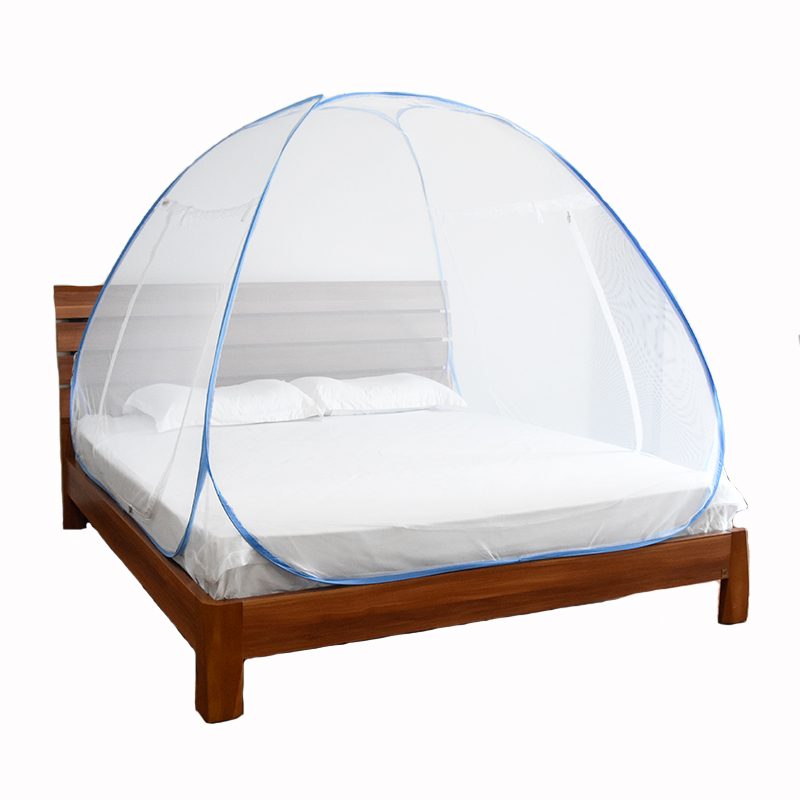
Structural Challenges in Pop-Up Mosquito Nets
The primary point of failure in low-grade pop-up nets is the internal frame. The spring steel wire inside the fabric sleeve must undergo repeated twisting and folding cycles without experiencing plastic deformation or snapping. When wire tension is too low, the net sags, reducing the internal volume and causing the mesh to touch the sleeper's skin, which permits mosquitoes to bite through the barrier. Conversely, if the wire tension is too high, it puts excessive stress on the surrounding fabric seams, leading to premature tearing.
High-Tensile Spring Steel Specifications
To maintain structural integrity over thousands of folding cycles, the wire frame must utilize high-carbon spring steel, typically coated with a rust-preventative zinc layer or wrapped in a protective PVC sleeve. Standard commercial models use wire diameters ranging from 2.0 mm to 2.4 mm, depending on the overall dimensions of the net. A larger double-bed net requires a slightly thicker wire to support the increased fabric weight, whereas single-bed or child-sized nets perform better with lighter, more flexible wires that reduce the overall packed weight.
Double-Needle Seam Construction
The channel holding the steel wire experiences continuous friction during deployment and storage. Standard single-stitch seams quickly unravel under this mechanical stress. Reliable manufacturers utilize double-needle chain stitching with high-strength polyester thread to reinforce these high-stress areas. The sleeve itself should be constructed from a dense, tightly woven Oxford fabric or heavy-duty polyester tape to prevent the wire ends from puncturing the casing over time.
Textile Specifications for Vector Interception
The protective value of a mosquito net depends heavily on its fabric composition. B2B buyers must evaluate several material metrics, including denier count, mesh density, and bursting strength, to ensure the product meets regional regulatory requirements and environmental conditions.
The choice between polyester and polyethylene mesh impacts both the weight and the durability of the final product:
Polyester Mesh (75D to 100D): Polyester is the most common material used in the foldable POP mosquito net wholesale market. It offers a soft texture, excellent drape, and high ventilation efficiency. A denier count of 75D provides a lightweight profile suitable for civilian travel, while 100D provides the extra tear resistance needed for military or humanitarian field deployments.
Polyethylene Mesh (100D to 150D): Polyethylene is typically used in heavy-duty agricultural or long-term vector control programs. It is more rigid and highly resistant to abrasion, though it exhibits less flexibility when folded into compact shapes.
Mesh density is calculated by counting the number of holes per square inch. The standard configuration for general protection is 156 holes per square inch (approx. 1.2 mm to 1.5 mm hole size). This configuration blocks standard *Anopheles* and *Aedes* mosquitoes while allowing adequate airflow in humid, tropical climates. For regions where smaller biting insects like sandflies or midges are prevalent, a denser mesh of 225 to 300 holes per square inch is recommended, though this will slightly reduce air circulation.
A net's ability to withstand accidental snags is measured using hydrostatic or pneumatic bursting strength tests (such as ISO 13938 standards). High-quality wholesale nets should achieve a minimum bursting pressure of 250 kPa for 75D polyester, ensuring that the fabric does not easily rupture when subjected to normal wear, handling, or contact with camp cots.
Logistical Efficiencies of Foldable POP Mosquito Net Wholesale Sourcing
Ocean and air freight rates are determined by both weight and volume. Traditional mosquito nets, while light, often require bulky support poles that increase packaging dimensions. The flat-folding circular profile of pop-up nets offers clear advantages for shipping and storage.
When collapsed, a pop-up net folds into a flat disc with a thickness of approximately 2 cm to 3 cm. This flat profile allows manufacturers to compress the units during final packaging. By using high-density hydraulic pressing, Yamei can pack up to 40 units into a single standard export carton, depending on the net dimensions. This high packing density maximizes the utilization of 40-foot High Cube (HQ) containers, significantly lowering the per-unit shipping cost for bulk importers.
In emergency response scenarios, such as natural disaster relief or sudden disease outbreaks, rapid distribution is key. Pop-up nets do not require assembly tools, hanging ropes, or ceiling hooks, allowing them to be unpacked and deployed in seconds inside temporary tents, gymnasiums, or outdoor camps. Sourcing foldable POP mosquito net wholesale shipments ensures that emergency relief organizations can deliver immediate, self-supporting protective shelters to affected populations without delay.
Customization Options and OEM Production
To satisfy diverse market demands, wholesale buyers often require specific design modifications. Yamei provides extensive OEM and ODM customization services to align products with target market expectations, regional climates, and distribution channels.
Standard pop-up designs feature either a single T-shaped zippered entrance or dual side openings. For residential markets, zippered doors allow easy entry and exit, but the zipper pull must be durable and operable from both inside and outside the net. Nylon coil zippers (No. 5 size) are preferred for their smooth operation and resistance to sand or dust interference. For humanitarian aid or budget-conscious distributions, zipperless overlapping doors provide a cost-effective, low-maintenance alternative that eliminates zipper failure points entirely.
Depending on the target demographic, the net footprint must be adjusted to match regional mattress dimensions. Common configurations include:
Single/Cot Size: 190 cm x 90 cm x 100 cm (L x W x H) - Ideal for military cots, youth hostels, and single beds.
Double/Queen Size: 200 cm x 150 cm x 150 cm (L x W x H) - Suitable for standard residential double beds.
King Size: 200 cm x 180 cm x 150 cm (L x W x H) - Designed for spacious master bedrooms and luxury glamping setups.
The bottom perimeter of the net is highly vulnerable to tears from mattress frames or ground debris. Adding a 10 cm to 15 cm protective taffeta skirt around the base shields the delicate mesh from wear, and also prevents mosquitoes from biting through the lower section if a sleeper's limbs press against the edge during the night.
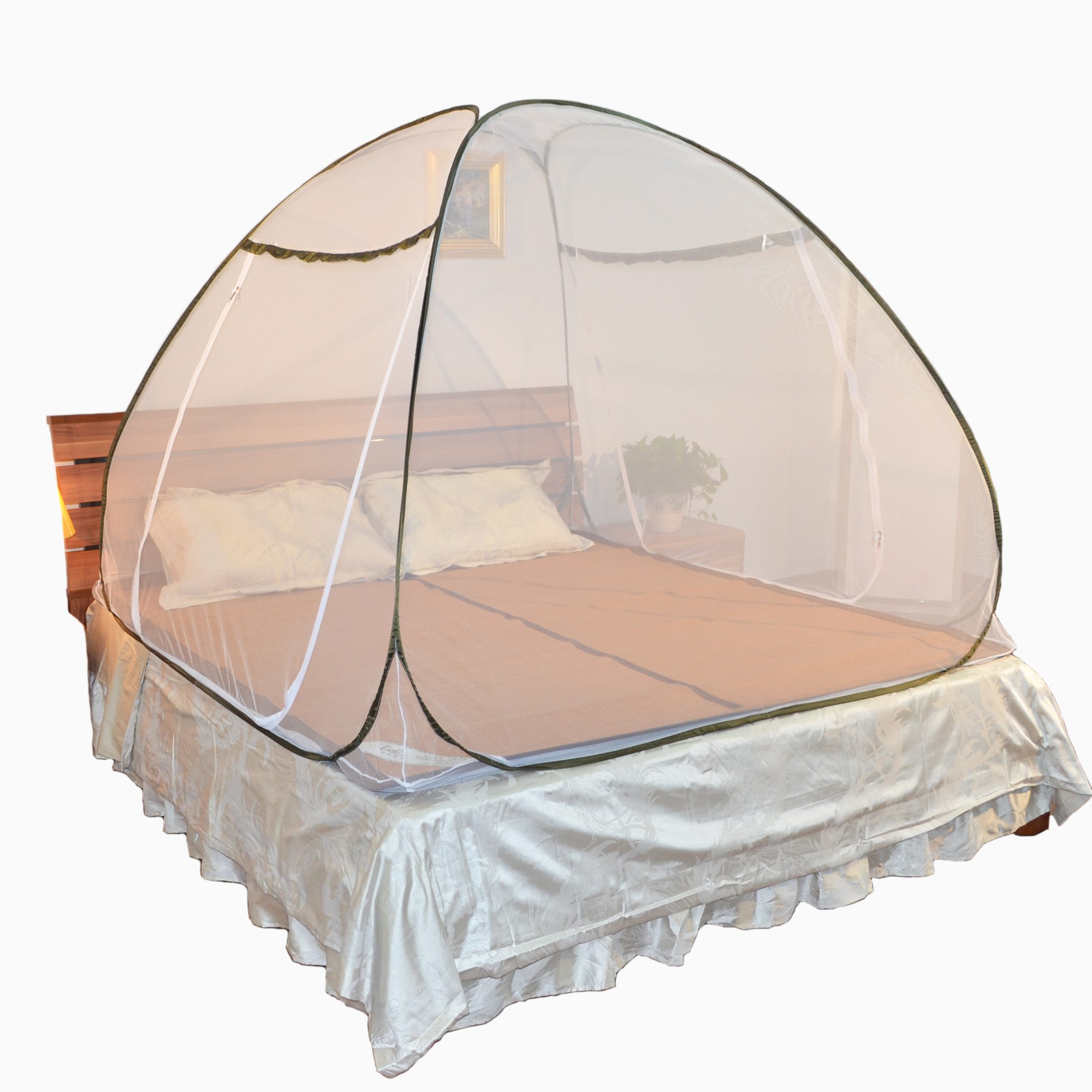
Quality Control Protocols in Bulk Production
Consistent manufacturing quality across thousands of units requires structured factory control protocols at every stage of production. Yamei maintains strict quality checks from raw material sourcing to final container loading.
The manufacturing process begins with inspection of the incoming polyester yarn and spring steel wire. Yarn lots undergo tensile testing to confirm denier consistency, and sample batches are dyed to verify colorfastness. The steel wire is tested for fatigue resistance by subjecting sample coils to rapid bending cycles before they enter the assembly line.
Weaving machines must run at consistent tensions to prevent irregular hole sizes. Automated optical scanners on the knitting machines identify and flag any dropped stitches or structural gaps in the mesh. Once the mesh fabric and steel frames are cut to specification, skilled operators assemble the nets on specialized sewing lines, where stitching tension is monitored to prevent puckering or weak seams.
Before packing, a random sampling of finished nets from each production lot is fully deployed and collapsed ten times consecutively. Inspectors check for frame symmetry, zipper functionality, seam straightness, and the absence of loose threads. Any batch that fails to meet the set tolerances is returned for rework, ensuring that only fully compliant products reach the logistics phase.
Initiating a Wholesale Inquiry
Navigating the complexities of bulk textile sourcing requires a manufacturing partner with proven engineering capability, scalable production capacity, and reliable export logistics. Yamei delivers compliant, durable, and highly packable pop-up mosquito nets tailored to your specific market requirements. Whether you are supplying humanitarian relief programs, distributing to outdoor retail chains, or stocking regional wholesale warehouses, our production facilities are equipped to handle large-scale orders with consistent quality.
To request detailed product catalogs, material certificates, or custom pricing models based on your target specifications, please contact our B2B sales team today. Provide your required dimensions, estimated order volume, and any custom packaging needs, and we will prepare a comprehensive quotation for your review.
Frequently Asked Questions (FAQ)
Q1: What is the typical lifespan of a pop-up mosquito net under regular field conditions?
A1: A well-manufactured pop-up net using 75D or 100D polyester and heat-treated spring steel wire typically lasts between 2 to 3 years under normal indoor use. In rugged field conditions, such as camping or emergency shelters, the lifespan is generally 12 to 18 months, depending on exposure to UV light and abrasive surfaces.
Q2: Can the wire frame rust if used in highly humid or coastal environments?
A2: To prevent oxidation, the high-carbon spring steel wire used in our nets is treated with a rust-preventative zinc coating or encased in a protective PVC sleeve. This barrier shields the steel from moisture and salt air, preventing rust from bleeding through the fabric casing.
Q3: How are the nets folded for storage, and will the frame deform if kept folded for long periods?
A3: The nets fold using a simple twist-and-loop mechanism that collapses the structure into a flat, circular disc. Our high-tensile spring steel features excellent elastic memory, meaning it can remain folded in its packaging for several months without experiencing permanent frame warping or loss of tension upon deployment.
Q4: Do you offer flame-retardant treatments for military or humanitarian relief orders?
A4: Yes. We can apply flame-retardant finishes during the fabric finishing process to meet specific safety standards, such as CPAI-84 or ISO standards, which are frequently required for military procurement and humanitarian aid distributions in camp environments.
Q5: What is the minimum order quantity (MOQ) for custom-branded foldable POP mosquito net wholesale orders?
A5: Our standard MOQ for custom sizes, specific mesh colors, or customized packaging designs is 1,000 units per specification. For standard in-stock colors and sizes, we can often accommodate smaller initial trial orders. Please contact our sales team to discuss your specific requirements.